
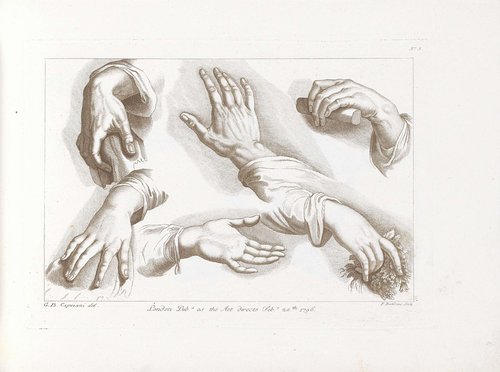
Zes handen
1796-02-23
Medium
etching
Dimensions
308; 216
Rights
Public Domain
About this artwork
verzamelaarsmerk, verso, gestempeld: Lugt 2760
Art Historical Context
Francesco Bartolozzi’s etching *Zes handen* (“Six Hands”), dated 23 February 1796, offers a delicate study of human hands rendered with the fine, precise lines characteristic of the medium. An Italian-born artist who spent much of his career London, Bartolozzi was celebrated for his reproductive prints after drawings and paintings by masters such as Guercino and Reynolds. Etching allowed him to capture subtle tonal gradations and anatomical detail while maintaining the spontaneity of the original sketches he translated. Measuring 216 by 308 millimetres, the print’s modest scale suits its intimate subject. The title suggests a focus on gesture and form, a popular theme among eighteenth-century artists and collectors interested in the expressive potential of the human body. A collector’s stamp (Lugt 2760) on the verso further indicates that the sheet once belonged to a discerning connoisseur, underscoring the long-standing appreciation for Bartolozzi’s refined graphic work. Today the etching invites viewers to consider both the technical mastery of late-eighteenth-century printmaking and the quiet eloquence of hands as subjects in their own right.
About the Artist
Francesco Bartolozzi · 1727–1815
Francesco Bartolozzi (1727–1815) was an Italian engraver whose most productive period was spent in London, where he became the leading exponent of stipple engraving and a founding member of the Royal Academy. Born in Florence and trained first as a painter before turning to engraving in Venice, he established his reputation in Rome before being recruited by the English Royal Librarian Richard Dalt...