
C.J. Knowles, 2nd plate
1826 to 1850
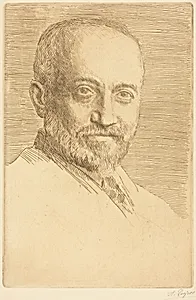
Medium
etching in dark brown ink
Classification
Department
CG-E
Museum
National Gallery of Art, Washington, D.C.
Credit
Gift of George Matthew Adams in memory of his mother, Lydia Havens Adams
Accession Number
1954.15.18
Rights
Public Domain
Art Historical Context
Alphonse Legros, a French-born artist who later worked in Britain, created *C.J. Knowles, 2nd plate* during the mid-19th century (ca. 1826–1850). This intimate etching in dark brown ink captures a portrait, likely of the titular figure, showcasing Legros' mastery of printmaking. As a key figure in the 19th-century Etching Revival, Legros the medium beyond mere reproduction, using it to achieve subtle tonal depths and expressive lines reminiscent of Rembrandt's influence. Etching involves coating a metal plate with acid-resistant ground, scratching designs into it, and immersing it in acid to etch lines that hold ink. Legros' choice of dark brown ink adds a warm, velvety richness, enhancing the psychological depth of the subject. Produced in an era when prints democratized art for wider audiences, this work exemplifies the technique's precision and artistry. Now housed in the National Gallery of Art's CG-E department (Prints classification), it was generously gifted by George Matthew Adams in memory of his mother, Lydia Havens Adams. Visitors appreciate its historical charm, bridging personal portraiture with innovative print traditions.
About the Artist
Alphonse Legros · 1837–1911
Alphonse Legros (1837–1911) was born in Dijon, France, and trained in Paris at the drawing school of Horace Lecoq de Boisbaudran, whose unconventional teaching method — which emphasised memory drawing and acute observation over academic convention — would leave a lasting mark on Legros's practice. At Lecoq's school he formed friendships with Jules Dalou and Auguste Rodin that endured throughout hi...