
Sir Edward John Poynter
1877
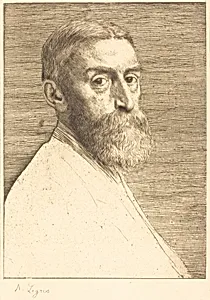
Medium
etching and drypoint in black on laid paper
Dimensions
plate: 25.7 x 17.1 cm (10 1/8 x 6 3/4 in.) sheet: 35 x 25.8 cm (13 3/4 x 10 3/16 in.)
Classification
Department
CG-E
Museum
National Gallery of Art, Washington, D.C.
Credit
Gift of Philip and Judith Benedict
Accession Number
1997.88.11
Rights
Public Domain
Art Historical Context
This striking portrait by Alphonse Legros captures Sir Edward John Poynter a leading Victorian painter and future president of the Royal Academy, in 1877. Legros, a French-born artist who settled in Britain and taught at the Slade School of Fine Art, created the work as an etching and drypoint on laid paper. The medium’s fine, incised lines and velvety drypoint burr allow for both precise detail and subtle tonal depth, reflecting the nineteenth-century revival of etching as a respected artistic practice. Legros’s restrained yet expressive approach highlights Poynter’s thoughtful gaze and formal attire, conveying the dignity of a fellow artist at the height of his career. Printed in black ink, the portrait exemplifies Legros’s skill in translating the immediacy of drawing into the more deliberate language of printmaking. Acquired by the National Gallery of Art as a gift from Philip and Judith Benedict, the sheet (measuring roughly 13¾ by 10 inches) preserves the intimate scale typical of such works on paper, inviting close viewing and appreciation of the printmaker’s craft.
About the Artist
Alphonse Legros · 1837–1911
Alphonse Legros (1837–1911) was born in Dijon, France, and trained in Paris at the drawing school of Horace Lecoq de Boisbaudran, whose unconventional teaching method — which emphasised memory drawing and acute observation over academic convention — would leave a lasting mark on Legros's practice. At Lecoq's school he formed friendships with Jules Dalou and Auguste Rodin that endured throughout hi...