
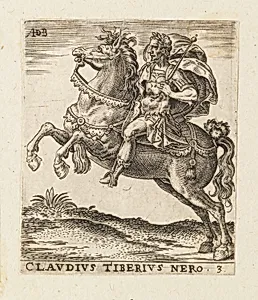
Claudius Tiberius Nero, from "Twelve Caesars on Horseback"
ca. 1565–87
Medium
Engraving
Dimensions
Sheet: 2 1/4 × 1 7/8 in. (5.7 × 4.8 cm)
Classification
Prints
Department
Drawings and Prints
Museum
Metropolitan Museum of Art, New York, NY
Credit
The Elisha Whittelsey Collection, The Elisha Whittelsey Fund, 1951
Accession Number
51.501.7755(3)
Rights
Public Domain
Tags
Art Historical Context
Behold the commanding figure of **Claudius Tiberius Nero**, emperor from 41 to 54 CE, captured in equestrian splendor by Flemish engraver Abraham de Bruyn in his series *Twelve Caesars on Horse* (ca. 1565–87). This tiny engraving, measuring just 2¼ × 1⅞ inches, transforms the historical ruler—known for his conquest of Britain and administrative reformsinto a heroic mounted warrior, evoking the timeless iconography of Roman power. De Bruyn, active in Antwerp during the Renaissance, drew inspiration from classical texts like Suetonius's *Lives of the Twelve Caesars*, blending historical reverence with artistic imagination. His series romanticized the emperors as riders, mirroring equestrian statues and triumphal processions that symbolized imperial might. Produced amid Europe's renewed fascination with antiquity, these prints served as affordable windows into the past for scholars, collectors, and the elite. Crafted via engraving—a meticulous intaglio technique where lines are incised into a metal plate for precise, durable reproductions—this work exemplifies 16th-century printmaking's role in democratizing art. Housed in The Metropolitan Museum of Art's Elisha Whittelsey Collection, it invites us to ponder how Renaissance artists reimagined Rome's legacy, bridging eras with a single, spirited gallop.