
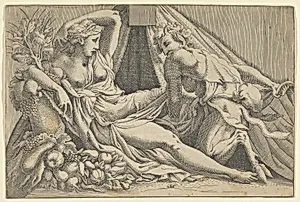
Jupiter and Antiope
Medium
Etching
Dimensions
Sheet (trimmed): 6 3/4 × 10 1/4 in. (17.1 × 26 cm)
Classification
Prints
Department
Drawings and Prints
Museum
Metropolitan Museum of Art, New York, NY
Credit
Harris Brisbane Dick Fund, 1932
Accession Number
32.92.5
Rights
Public Domain
Tags
Art Historical Context
Behold *Jupiter and Antiope a captivating etching from 154045 by Antonio Fantuzzi Francesco Primaticcio, Italian masters of the Fontainebleau School. This intimate print (6 3/4 × 10 1/4 in.) captures a mythological moment from Ovid's *Metamorphoses*: Jupiter, king of the gods, disguised a satyr, approaches the nymph Antiope amid a lively scene of satyrs. The artists' elegant, elongated figures and dynamic poses exemplify Mannerism, a stylish evolution of Renaissance ideals that emphasized grace and artifice. Created at the opulent Palace of Fontainebleau under French King Francis I's patronage, the work reflects the cultural fusion of Italian sophistication and French innovation during the 16th century. Etching, the medium here, allowed for fluid, spontaneous lines—more painterly than traditional engraving—making complex compositions like this accessible through prints, which spread Mannerist motifs across Europe. Housed in the Metropolitan Museum of Art's Drawings and Prints department (Harris Brisbane Dick Fund, 1932), this piece highlights the era's fascination with classical mythology, blending eroticism, divinity, and nature. It's a window into how Renaissance artists reimagined ancient tales for enlightened courts, inviting us to marvel at their technical prowess and imaginative flair.
About the Artist
Antonio Fantuzzi|Francesco Primaticcio · 1537–1545
**Antonio Fantuzzi** (active 1537–1550) was an Italian painter and printmaker born in Bologna who played a significant role in the First School of Fontainebleau during the French Renaissance. He worked in a Mannerist style, contributing to the lavish decorations of the Palace of Fontainebleau under royal patronage. Fantuzzi is recorded as a painter at Fontainebleau from 1537 onward, initially on ...