
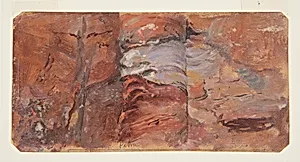
Cliff Face, Petra, Syria (Jordan)
February 25, 1868
Medium
nature studies
Classification
nature studies
Department
Smithsonian Collection
Museum
Smithsonian American Art Museum
Credit
Gift of Louis P. Church
Accession Number
1917-4-813-b
Rights
Public Domain
About this artwork
Research in Progress
Art Historical Context
Step into the dramatic cliffs of Petra with Frederic Edwin Church's *Cliff Face, Petra, (Jordan)*, a nature study dated February 25, 1868. As a leading figure of the River School, Church was renowned for his luminous landscapes that captured the sublime power of nature. This intimate oil sketch, now in the Smithsonian American Art Museum, reflects his meticulous on-site observations during an ambitious 1867–68 expedition to the Middle East, including the ancient Nabataean city of Petra in modern-day Jordan—famously carved into rose-red sandstone cliffs. Church's nature studies like this one were essential precursors to his grand canvases, allowing him to document light, texture, and geological details with scientific precision. Here, the towering cliff face evokes the region's biblical and exotic allure, blending Romantic awe with emerging ideas of scientific exploration. Created amid Church's quest to depict Holy Land wonders, it showcases his innovative plein air technique, bridging American landscape tradition with global wanderlust. A gift from his son Louis P. Church, this work invites us to appreciate Petra's timeless majesty through 19th-century eyes, highlighting how such studies fueled Church's epic visions of the world's natural cathedrals.