
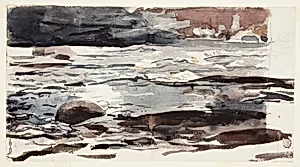
Woodland Stream
Medium
landscapes
Classification
landscapes
Department
Smithsonian Collection
Museum
Smithsonian American Art Museum
Credit
Gift of Charles Savage Homer, Jr.
Accession Number
1912-12-2
Rights
Public Domain
About this artwork
Recto: A stream punctuated by boulders in the white-capped, steel-gray waters; Verso: arithmetic notations in graphite, a sketch of a Chinese vase on a pedestal, two unfinished male torsos, and portion of dog's head similar to head of dog in "Huntsman and Dogs".
Art Historical Context
**Woodland Stream** (1895) by Winslow Homer captures the power of nature in a quintessential American landscape. On the recto, Homer depicts a rushing stream dotted with boulders amid white-capped, steel-gray waters, evoking turbulent energy of a woodland waterway. Created during Homer's later years at his Prouts Neck, Maine, this work reflects his mastery of Realism, where he shifted from Civil War scenes and marine subjects to intimate studies of the American wilderness. As a leading figure in 19th-century American art, Homer's landscapes celebrated the untamed beauty of the Northeast, influencing generations with their direct, unromanticized observation of light, water, and motion. The artwork's medium—likely watercolor on paper, given Homer's signature technique—highlights his innovative use of transparent layers to convey depth and movement in fluid elements like streams and waves. Its presence in the Smithsonian American Art Museum, gifted by Homer's family, underscores its place in the canon of American landscape tradition. Turning the piece over reveals the artist's working process: graphite notations including arithmetic, a sketch of a Chinese vase on a pedestal, two unfinished male torsos, and part of a dog's head akin to one in his *Huntsman and Dogs*. This verso offers a rare glimpse into Homer's multifaceted creativity, blending everyday jottings with exploratory drawings.