
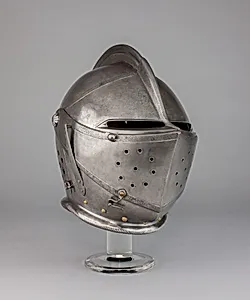
Close Helmet
1610/20
Medium
Steel and gilding
Dimensions
H.: 29.2 cm (11 1/2 in.)
Classification
suit-helmet
Department
Applied Arts of Europe
Museum
Art Institute of Chicago
Accession Number
106368
Rights
Public Domain
About this artwork
During its conflict with the Spanish Habsburgs during the first half of the 17th century, the Netherlands experienced a flowering of the armor’s art. Once part of a heavy cavalry armor, this helmet with rounded forms and crisp lines exemplifies the best of Dutch workmanship.
Art Historical Context
This exquisite Close Helmet, crafted around 1610–20, exemplifies the pinnacle of European armor-making during the early 17th century. of steel with intricate gilding, it just 29.2 cm in height, designed to fully enclose the wearer's head for maximum protection in battle. As part of a suit of armor, it reflects the transition from Renaissance pageantry to the gritty conflicts of the Thirty Years' War era, when plate armor was still vital for cavalry and infantry despite advancing firearms. The unknown artisan's mastery shines in the helmet's robust steel construction—forged, shaped, and polished to deflect blows—enhanced by gilding that added a luxurious sheen. This decorative gold leaf not only elevated its aesthetic appeal but also signified the status of its owner, blending functionality with artistry in the Applied Arts of Europe tradition. Housed in the Art Institute of Chicago, this helmet invites us to ponder the human drama of early modern warfare: the clash of steel, the weight of chivalry, and the fleeting elegance of gilded defense. A testament to skilled metalwork, it captures a world where beauty and brutality intertwined.
About the Artist
Unknown
The artist designated as "Unknown" in our virtual museum's collection exemplifies a poignant chapter in art history: creators whose identities have faded into obscurity despite the enduring power of their work. With only one known artwork attributed to them in our holdings, this figure represents countless anonymous hands that shaped visual culture across centuries. Museums worldwide, including th...