
Club Table (Tischgesellschaft)
published 1907
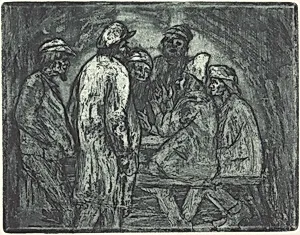
Medium
etching and soft-ground etching in blue-gray
Classification
Department
CG-W
Museum
National Gallery of Art, Washington, D.C.
Credit
Epstein Family Fund
Accession Number
1980.33.2
Rights
Public Domain
Art Historical Context
Emil Nolde’s *Club Table (Tischgesellschaft)*, published in 1907, presents a gathering of figures around a table in a quiet, atmospheric scene. Created as an etching and soft-ground etching printed in blue-gray, the work uses the intaglio process to build rich textures and subtle tonal variations that suggest both the intimacy of a social club and a certain psychological distance among the participants. Nolde, a leading German Expressionist, was celebrated for emotionally intense paintings, yet he was equally inventive as a printmaker. Soft-ground etching allowed him to capture a more painterly, velvety quality than traditional hard-ground etching, while the restricted palette focuses attention on line, shadow, and mood rather than color. In 1907, as Expressionism was taking shape in Germany, such prints helped artists circulate modern ideas beyond the studio. This impression, now in the National Gallery of Art, belongs to Nolde’s early graphic experiments and reminds us how printmaking served both artistic exploration and wider public reach at the turn of the twentieth century.
About the Artist
Emil Nolde · 1867–1956
Emil Nolde, born Hans Emil Hansen on August 7, 1867, near the village of Nolde in what was then Prussian Schleswig (now Denmark), grew up on a farm amid devout Protestant Danish and Frisian peasant parents. The youngest of four brothers, he apprenticed as a woodcarver and illustrator in Flensburg from 1884 to 1891, working in furniture factories before studying at the School of Applied Arts in Kar...