
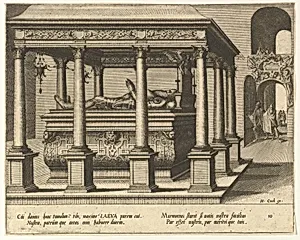
Cœnotaphiorum (10)
Medium
Etching; first state of four
Dimensions
sheet: 6 5/8 x 8 1/4 in. (16.8 x 21 cm)
Classification
Prints|Ornament & Architecture
Department
Drawings and Prints
Museum
Metropolitan Museum of Art, New York, NY
Credit
Purchase, Phyllis D. Massar Gift, 2011
Accession Number
2011.510.10
Rights
Public Domain
Tags
Art Historical Context
In the bustling print workshops of 16th Antwerp, *Cœnotaphiorum (10)* (1563) emerged as plate 10 from a captivating series of imaginary cenotaphs—elaborate, empty tombs designed to honor the illustrious dead. Created by the visionary architect and designer Hans Vredeman de, with masterful etchings by the van Doetecum brothersJohannes and Lucas) published by Hieronymus, this print exemplifies the genius of the Northern Renaissance. Vredeman's intricate Mannerist architecture, filled with towering columns, ornate tombs, and poised male figures, reflects the era's fascination with perspective, classical antiquity, and fantastical ornamentation. As a first-state etching—measuring just 6 5/8 x 8 1/4 inches—this rare impression captures the artwork in its purest form, before later editions added refinements. Etching allowed for fine, fluid lines that brought architectural grandeur to life on paper, making such opulent designs accessible beyond elite patrons. Produced amid the Protestant Reformation's upheavals, these prints celebrated humanist ideals through invented splendor, influencing architects and decorators across Europe. Today, at The Metropolitan Museum of Art, this gem from the Drawings and Prints department invites us to marvel at Renaissance ingenuity: a tiny window into a world where art blurred the line between reality and dreamlike monumentality.