
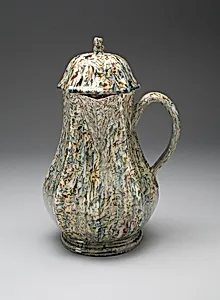
Coffee Pot
1750/65
Medium
Lead-glazed earthenware (agateware)
Dimensions
27.4 × 18.5 × 12.9 cm (10 3/4 × 7 1/4 × 5 1/16 in.)
Classification
earthenware
Department
Applied Arts of Europe
Museum
Art Institute of Chicago
Accession Number
67397
Rights
Public Domain
Art Historical Context
This elegant coffee pot, crafted around 1750–65, exemplifies the refined applied arts of 18th-century Europe. Made of lead-glazed earthenware in the distinctive agateware technique, it features a marbled surface that mimics the swirling bands of natural agate stone. Artisans achieved this effect by layering and twisting clays of contrasting colors—often white, black, and brown—before firing, creating a luxurious, stone-like illusion in an affordable ceramic medium. Standing at 27.4 × 18.5 × 12.9 cm, its baluster shape, spout, and handle blend practicality with graceful proportions, ideal for serving the era's fashionable beverage. The mid-18th century marked coffee's meteoric rise in Europe, fueled by expanding trade and coffeehouse culture in cities like London and Paris. Pots like this one, produced in workshops across England or the Continent, democratized luxury for the growing middle class. Lead glazing provided a glossy, impermeable finish, enhancing durability and sheen while allowing vibrant decorative effects. Housed in the Art Institute of Chicago's Department of Applied Arts of Europe, this anonymous masterpiece highlights ceramics' role in everyday elegance. Its survival underscores the technical prowess of unnamed potters, bridging utility and artistry in a transformative age of consumption.
About the Artist
Unknown
The artist designated as "Unknown" in our virtual museum's collection exemplifies a poignant chapter in art history: creators whose identities have faded into obscurity despite the enduring power of their work. With only one known artwork attributed to them in our holdings, this figure represents countless anonymous hands that shaped visual culture across centuries. Museums worldwide, including th...