
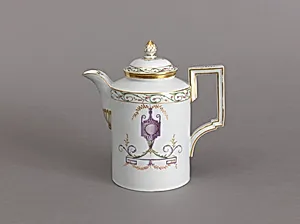
Coffeepot with Urn Pattern
Classification
ceramics
Department
Smithsonian Collection
Museum
Smithsonian American Art Museum
Credit
Bequest of Erskine Hewitt
Accession Number
1938-57-675-a,b
Rights
Public Domain
About this artwork
Research in Progress
Art Historical Context
This elegant coffeepot with urn pattern was produced by the Fürstenberg Porcelain Manufactory between 1780 and 1800. Established in1747 in the German state of Brunswick, Fürstenberg was among the earliest porcelain factories in Europe, creating refined tableware for aristocratic and middle-class households alike. The urn motif, drawn from classical antiquity, reflects thelassical taste that swept across Europe in the late eighteenth century, inspired by archaeological discoveries in Pompeii and Herculaneum. As a functional yet decorative object, the coffeepot exemplifies how ceramics bridged art and daily life during this period. Its clean lines and restrained ornamentation suited the emerging preference for simplicity and symmetry over the elaborate rococo styles of earlier decades. Though the precise technique remains under study, pieces from this era often featured hand-painted or transfer-printed designs that highlighted both the factory’s technical skill and the cultural fascination with ancient forms. Today, this work resides in the Smithsonian American Art Museum’s collection through the bequest of Erskine Hewitt, offering visitors a glimpse into Enlightenment-era European craftsmanship and the enduring appeal of classical motifs in domestic objects.