
Coin
Unknown Artist
4th century
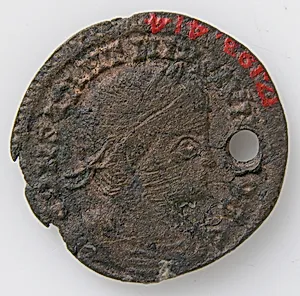
Medium
Copper alloy (cards say bronze)
Dimensions
Overall: 5/8 x 1/16 in. (1.6 x 0.1 cm)
Classification
Coins
Culture
Byzantine
Department
Medieval Art
Museum
Metropolitan Museum of Art, New York, NY
Credit
Gift of J. Pierpont Morgan, 1917
Accession Number
17.193.414
Rights
Public Domain
Tags
Art Historical Context
This diminutive copper alloy coin, often referred to as bronze in museum labels, hails from the 4th century during the early Byzantine Empire—a pivotal era when Emperor Constantine I established Constantinople as the new Rome in 330 AD. Measuring just 5/8 x 1/16 inches, it exemplifies the everyday artistry of Byzantine numismatics, bridging late Roman traditions with the emerging Christian East. Produced in imperial mints, such coins circulated widely, facilitating trade across a vast empire stretching from the Mediterranean to the Black Sea. Featuring profile portraits—likely of an emperor on the obverse—the coin served as potent propaganda, immortalizing rulers' authority through finely engraved dies. Struck under high pressure, the technique created raised reliefs that captured subtle facial details despite the metal's modest durability. These "profiles" tags highlight their classical Roman influence, adapted for Byzantine iconography that would evolve to include Christian symbols in later centuries. Now housed in the Metropolitan Museum of Art's Medieval Art Department, thanks to a 1917 gift from J. Pierpont Morgan, this coin offers a tangible glimpse into Byzantine economic life and cultural continuity. Though anonymous in its creation, it whispers of an empire's resilience, reminding us how even pocket change shaped history.