
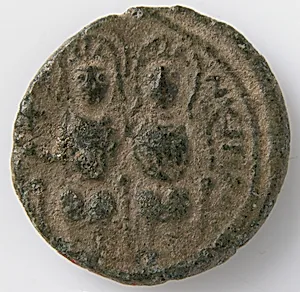
Coin of Justin II
Unknown Artist
6th century (572–573)
Medium
Copper alloy (card says bronze)
Dimensions
Overall: 13/16 x 1/8 in. (2.1 x 0.3 cm)
Classification
Coins
Culture
Byzantine
Department
Medieval Art
Museum
Metropolitan Museum of Art, New York, NY
Credit
Gift of Albert M. Lythgoe, 1917
Accession Number
17.6.95
Rights
Public Domain
Art Historical Context
Behold the *Coin of Justin II*, modest yet mighty artifact from the Byzantine Empire's6th century (struck in 572–573 CE). Crafted from copper alloy—often referred to as bronze—this tiny treasure measures just 13/16 x 1/8 inch (2.1 x 0.3 cm), small enough to slip into a pocket but emblematic of imperial power. Minted during the reign of Emperor Justin II (r. 565–578 CE), it served as everyday currency in Constantinople and beyond, blending Roman traditions with emerging Christian symbolism. Byzantine coins like this one were masterful tools of propaganda and economy. The obverse likely bore the emperor's portrait, asserting his divine-right rule amid turbulent times—plagues, Persian threats, and Lombard invasions challenged the empire's eastern Roman legacy. Techniques involved striking metal blanks between engraved dies, capturing fine details in hair, drapery, and inscriptions that proclaimed imperial authority. As a low-denomination piece, it circulated widely among merchants and soldiers, reflecting Byzantium's sophisticated monetary system. Housed in the Metropolitan Museum of Art's Medieval Art Department (gift of Albert M. Lythgoe, 1917), this coin offers a window into a pivotal era when the empire fortified its Christian identity. Though unassuming, it whispers tales of resilience, trade, and the enduring art of numismatics.