
Coin Depicting a Boeotian Shield
196-146 BCE
Medium
Bronze
Dimensions
Diam.: 1.4 cm (9/16 in.)
Classification
coin
Department
Arts of Greece, Rome, and Byzantium
Museum
Art Institute of Chicago
Accession Number
142729
Rights
Public Domain
About this artwork
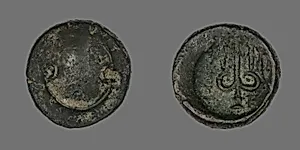
The front (obverse) of this coin depicts a Boeotian shield while the back (reverse) shows the upper part of an ornamental trident.
Art Historical Context
This tiny bronze coin, struck in ancient Greece between 196 and 146 BCE, showcases a Boeotian shield on its surface—a distinctive, crescent-shaped hoplon emblematic of warriors from Boeotia, the central Greek region famed for its powerful city-state Thebes. Measuring just 1.4 cm in diameter, it exemplifies the exquisite miniaturization of Hellenistic coinage, where engravers crafted intricate dies to imprint symbols of regional pride and military prowess onto metal blanks under immense pressure. Such coins were everyday currency, circulating widely amid the turbulent politics of the era. Historically, this period marked Greece's fragile independence following Roman victories over Macedon (like the 196 BCE Battle of Cynoscephalae) and culminating in the sack of Corinth in 146 BCE. The Boeotian shield likely advertised local identity and resilience, serving as both propaganda and practical money in a time of shifting alliances between Greek leagues and Rome. As a bronze issue—less precious than silver but durable for commerce—it reflects the economic vitality of Boeotian mints. Today, housed in the Art Institute of Chicago's Arts of Greece, Rome, and Byzantium department, this unassuming artifact reveals the artistry of ancient numismatics: a window into daily life, valor, and the blend of utility and symbolism that defined Greek culture.
About the Artist
Ancient Greek
The artist known simply as "Ancient Greek" represents the anonymous masters of Attic vase painting, a cornerstone of Classical Greek art from the Archaic and Classical periods (circa 700–300 BCE). Little is known of their personal life, as ancient Greek potters and painters rarely signed their works or left biographical traces; early life and training remain not well documented. These creators ope...