
Coin Portraying Emperor Constantius II
after 340
Medium
Bronze
Dimensions
Diam.: 1.5 cm (5/8 in.)
Classification
coin
Department
Arts of Greece, Rome, and Byzantium
Museum
Art Institute of Chicago
Accession Number
142626
Rights
Public Domain
About this artwork
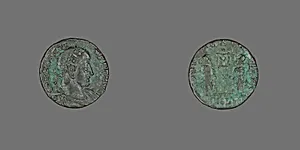
The front (obverse) of this coin portrays the emperor Constantius II, facing right and wearing a diadem. On the back (reverse) a type of military standard called a labarum is flanked by two soldiers.
Art Historical Context
This petite bronze coin, struck after 340 CE during the reign of Emperor Constant II (r. 337–361 CE), offers a glimpse into the grandeur of the late Roman Empire. As the son of Constantine the Great, Constantius ruled amid turbulent times, including civil wars and the empire's shift toward Christianity. Measuring just 1.5 cm in, such coins—likely a type of nummus—were currency circulated across the vast Roman world, from Britain to the eastern frontiers. On the obverse, the emperor's idealized portrait, often laureate and draped in military attire, symbolized imperial power and divine favor, a hallmark of Roman numismatic art. The reverse typically featured deities, victories, or imperial mottos, blending propaganda with artistry through fine engraving techniques that captured intricate details despite the small scale. Bronze, an accessible medium, allowed mass production via dies, making these coins both economic tools and portable emblems of Rome's enduring legacy. Housed in the Art Institute of Chicago's Arts of Greece, Rome, and Byzantium department, this artifact highlights how Roman coinage bridged art, politics, and daily life, preserving the emperor's visage for posterity long after his era.
About the Artist
Ancient Roman
The artists attributed to "Ancient Roman" in museum collections represent the anonymous craftsmen who produced the vast output of sculpture, frescoes, mosaics, and reliefs defining Roman visual culture from the Republic (c. 509–27 BCE) to the late Empire (c. 395 CE). Individual identities remain elusive, as Roman makers were typically viewed as skilled tradesmen—often enslaved Greeks or provincial...