
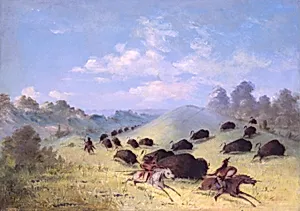
Comanche Indians Chasing Buffalo with Lances and Bows
1846-1848
Medium
Painting
Classification
Painting
Department
Smithsonian Collection
Museum
Smithsonian American Art Museum
Credit
Smithsonian American Art Museum, Gift of Mrs. Joseph Harrison, Jr.
Accession Number
1985.66.564
Rights
Public Domain
Tags
About this artwork
George Catlin enjoyed and documented buffalo hunts with various tribes, describing methods such as the exhilarating but dangerous chase on horseback, the surround, and the ambush, in which hunters crept among the unsuspecting herds disguised under the skin of a white wolf for a close and easy shot. During the 1830s, many Indians still used the ambush, but the acquisition of the horse centuries before had transformed their hunting methods. The tribes could now hunt with less danger to themselves ...
Art Historical Context
George Catlin's *Comanche Indians Chasing Buffalo Lances and Bows (1846-1848) captures the raw thrill of a buffalo hunt on the Great Plains, showcasing the Comanche people's mastery as horsemen. Painted during Catlin's later career, this oil on canvas reflects his lifelong passion for documenting Native American life before it vanished under westward expansion. In the 1830s, Catlin witnessed various hunting methods—exhilarating horseback chases, surrounds, and stealthy ambushes using wolf skins for disguise. The Comanche, whom he hailed as the finest Plains riders, had revolutionized hunting centuries earlier with horses acquired from Spanish explorers, enabling safer, more successful pursuits with lances and bows. This dynamic scene highlights Catlin's realistic style, blending Romantic energy with ethnographic precision to freeze motion-packed action: warriors thundering after buffalo herds. As part of the Smithsonian American Art Museum's collection (gift of Mrs. Joseph Harrison, Jr.), it preserves a vanishing world, underscoring the cultural significance of buffalo hunts central to Comanche survival, spirituality, and prowess. Today, it invites visitors to ponder the horse's transformative role in Indigenous history.
About the Artist
George Catlin · 1796–1872
George Catlin (1796–1872), born in Wilkes-Barre, Pennsylvania, to Putnam Catlin and Polly Sutton—who had been captured by Native Americans during the 1778 Battle of Wyoming—initially pursued a legal career. Trained at Litchfield Law School, he was admitted to the bar in 1819 but abandoned law after two years to study art in Philadelphia in 1823. Self-taught as a portraitist, Catlin quickly gained ...