
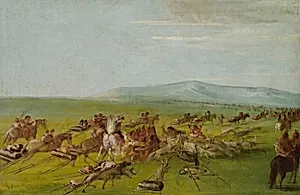
Comanche Moving Camp, Dog Fight Enroute
1834-1835
Medium
Painting
Classification
Painting
Department
Smithsonian Collection
Museum
Smithsonian American Art Museum
Credit
Smithsonian American Art Museum, Gift of Mrs. Joseph Harrison, Jr.
Accession Number
1985.66.466
Rights
Public Domain
Tags
About this artwork
“In speaking . . . of the mode of moving their wigwams, and changing their encampments, I should have . . . given to the reader, a sketch of one of these extraordinary scenes, which I have had the good luck to witness; where several thousands were on the march, and furnishing one of those laughable scenes which daily happen, where so many dogs, and so many [women], are traveling in such a confused mass; with so many conflicting interests, and so many local and individual rights to be pertinaciou...
Art Historical Context
George Catlin's *Comanche Moving Camp, Dog Enroute* (1834-1835) captures a lively, chaotic moment from Comanche daily life on the vast plains. Painted after Catlin sketched the scene firsthand at a Comanche village his 1830s travels across the American West, the work reflects the artist's lifelong passion for documenting Native American cultures before they were transformed by European expansion. As a pioneering ethnographer and Romantic painter, Catlin aimed to create an authentic visual record, blending keen observation with dramatic energy. In this vibrant painting, a nomadic encampment is on the move: horses drag loads, reluctant dogs haul wallets on poles, and women balance burdens amid the fray. As Catlin described in his *Letters and Notes* (1841), the action erupts from pugnacious dogs, escalating into women's fisticuffs—much to the amusement of leisurely mounted men. The composition teems with figures, emphasizing the "confused mass" of conflicting interests in this figure-group scene. Housed in the Smithsonian American Art Museum, the painting offers invaluable insight into Comanche resilience and humor during migration. It highlights their equestrian prowess and communal spirit, preserving a fleeting world of Plains Indian life for modern viewers.
About the Artist
George Catlin · 1796–1872
George Catlin (1796–1872), born in Wilkes-Barre, Pennsylvania, to Putnam Catlin and Polly Sutton—who had been captured by Native Americans during the 1778 Battle of Wyoming—initially pursued a legal career. Trained at Litchfield Law School, he was admitted to the bar in 1819 but abandoned law after two years to study art in Philadelphia in 1823. Self-taught as a portraitist, Catlin quickly gained ...