
Combing His Hair
1770
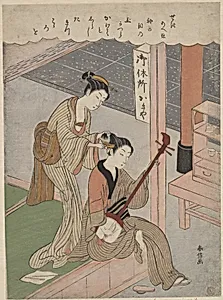
Medium
Woodblock print; ink and color on paper
Dimensions
H. 11 1/8 in. (28.3 cm); W. 8 1/8 in. (20.6 cm)
Classification
Prints
Culture & Period
Japan · Edo period (1615–1868)
Department
Asian Art
Museum
Metropolitan Museum of Art, New York, NY
Credit
Rogers Fund, 1921
Accession Number
JP1219
Rights
Public Domain
Tags
Art Historical Context
Suzuki Harunobu's *Combing His Hair* (1770) is a delicate woodblock print from Japan's Edo period (16151868), capturing the essence of ukiyo-e, the "floating world" genre that celebrated everyday pleasures, beauty, and urban life in Edo (modern Tokyo). Harunobu, a master of this style, pioneered full-color nishiki-e prints around 1765, revolutionizing Japanese printmaking with vibrant inks layered on paper. This intimate scene, measuring just 11⅛ × 8⅛ inches, likely depicts a tender moment of grooming amid figures with musical instruments, evoking the refined world of courtesans, artisans, and performers. The print's significance lies in its technical brilliance: artisans carved intricate woodblocks for each color, allowing Harunobu's subtle gradations and textures to shine, from silky hair to patterned kimonos. Hair combing held deep cultural resonance in Edo Japan, symbolizing elegance, status, and ritual—elaborate styles signified one's role in society, whether samurai, merchant, or geisha. Tags highlighting men, women, musical instruments, and hair suggest a domestic or performative tableau, blending sensuality with harmony. Acquired through the Rogers Fund in 1921, this Metropolitan Museum of Art treasure offers visitors a window into 18th-century Japan's playful artistry, where the mundane became poetry.
About the Artist
Suzuki Harunobu · 1725–1770
Suzuki Harunobu (c. 1725-1770) was a Japanese ukiyo-e artist who revolutionized woodblock printing by developing nishiki-e—full-color prints using multiple woodblocks—in 1765. Before Harunobu, Japanese prints were limited to two or three colors; his innovation unleashed the entire artist's palette, transforming ukiyo-e into the vibrant art form that would later captivate Western artists from Manet...