
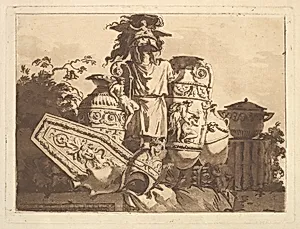
Composition with antiquities, from Recueil de Compositions par Lagrenée Le Jeune (Collection of Compositions by Lagrenée the Younger)
1782–84
Medium
Etching and aquatint
Dimensions
Sheet: 15 13/16 × 21 7/16 in. (40.2 × 54.5 cm) Plate: 8 1/2 × 11 3/8 in. (21.6 × 28.9 cm)
Classification
Prints|Ornament & Architecture
Department
Drawings and Prints
Museum
Metropolitan Museum of Art, New York, NY
Credit
Purchase, The Arthur Ross Foundation Gift and Charles Z. Offin Fund, 1999
Accession Number
1999.2(2)
Rights
Public Domain
Tags
About this artwork
Composition with antiquities, from Recueil de Compositions par Lagrenée Le Jeune (Collection of Compositions by Lagrenée the Younger) is a prints|ornament & architecture by French artist Jean Jacques Lagrenée, created in 1782–84. The work was created using etching and aquatint. It measures Sheet: 15 13/16 × 21 7/16 in. (40.2 × 54.5 cm) Plate: 8 1/2 × 11 3/8 in. (21.6 × 28.9 cm). Printmaking during this period was an essential medium for disseminating artistic imagery and ideas across broad audie...
Art Historical Context
In the late 18th century, artist Jean-Jacques Lagrenée the Younger, a prominent neoclassical painter and draftsman, *Composition with Antiquities* as part of his *Recueil de Compositions (Collection of Compositions published between 1782 and 1784. This etching and aquatint print exemplifies the's fascination with ancient Greco-Roman artifacts, featuring motifs like helmets, vases, and graceful female figures arranged in an ornamental design. Classified under Prints: Ornament & Architecture, reflects neoclassicism's emphasis on classical harmony and proportion, drawing inspiration from archaeological discoveries that fueled the Enlightenment's revival of antiquity. Lagrenée's mastery of etching—incising lines into a metal plate with acid—and aquatint, which adds rich tonal gradations for a painterly effect, made such prints ideal for reproducing intricate details affordably. During this period, prints like this one were prized by collectors, architects, and designers, serving as both aesthetic treasures and practical sources for decorative motifs in furniture, interiors, and buildings. They democratized access to sophisticated ornamentation, bridging fine art and applied design. Today, this work graces the Metropolitan Museum of Art's Drawings and Prints department, acquired in 1999 through the Arthur Ross Foundation Gift and Charles Z. Offin Fund. Measuring a generous sheet size of 15 13/16 × 21 7/16 inches, it invites visitors to appreciate how 18th-century innovators like Lagrenée preserved and reimagined the grandeur of the ancient world.
About the Artist
Jean Jacques Lagrenée · 1739–1821
Jean-Jacques Lagrenée, known as Lagrenée the Younger (1739–1821), was a distinguished French history painter, draftsman, and engraver born into a family of artists in Paris. The younger brother of the prominent Louis-Jean-François Lagrenée (Lagrenée the Elder), he studied under his elder sibling at the École nationale supérieure des beaux-arts in Paris, honing his skills in the rigorous academic t...