
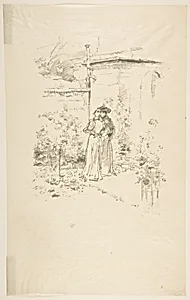
Confidences in the Garden
Medium
Transfer lithograph; only state (Chicago); printed in black ink on fine cream laid Japanese paper
Dimensions
Image: 8 3/8 × 6 5/16 in. (21.2 × 16 cm) Sheet: 13 5/8 × 8 7/16 in. (34.6 × 21.5 cm)
Classification
Prints
Department
Drawings and Prints
Museum
Metropolitan Museum of Art, New York, NY
Credit
Harris Brisbane Dick Fund, 1917
Accession Number
17.3.206
Rights
Public Domain
Tags
Art Historical Context
James McNeill Whistler’s *Confidences in the Garden* (1894) captures an intimate moment between two women seated amid lush foliage, their heads bent close in whispered conversation. Created during the artist’s later years, this transfer lithograph reflects Whistler’s mastery of subtle tonal effects and his fascination with Japanese aesthetics, evident in the fine cream laid Japanese paper that enhances the delicate blacks and whites. The scene evokes the quiet beauty of private gardens, a recurring motif in his work that celebrates harmony and suggestion over narrative detail. As a pioneering figure in Aestheticism, Whistler prioritized “art for art’s sake,” using lithography to achieve painterly qualities akin to his famous nocturnes and etchings. This print, in its only state printed in Chicago, showcases the transfer technique—where the image is drawn on paper and transferred to a lithographic stone—allowing for precise, velvety textures and atmospheric depth. Measuring just 8 3/8 × 6 5/16 inches, its small scale invites close contemplation, much like a whispered confidence. Acquired through the Harris Brisbane Dick Fund in 1917, this gem from the Metropolitan Museum of Art’s Prints collection highlights Whistler’s influence on modern printmaking, bridging 19th-century experimentation with 20th-century abstraction. Visitors will appreciate its serene elegance, a testament to the artist’s lifelong pursuit of beauty in everyday tranquility.
About the Artist
James McNeill Whistler · 1834–1903
James Abbott McNeill Whistler (1834-1903) was an American-born painter and printmaker who became a leading figure in the Aesthetic Movement and pioneer of Tonalism and Japonisme. He revolutionized art by championing "art for art's sake" and treating paintings as visual equivalents of musical compositions, titling works as "arrangements," "harmonies," and "nocturnes" to emphasize formal qualities o...