
Convivio delle Belle Donne, page 21 (recto)
August 1532
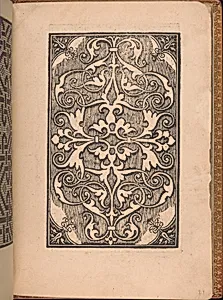
Medium
Woodcut
Dimensions
Overall: 7 7/8 x 5 1/2 in. (20 x 14 cm)
Classification
Books|Prints|Ornament & Architecture
Department
Drawings and Prints
Museum
Metropolitan Museum of Art, New York, NY
Credit
Rogers Fund, 1922
Accession Number
22.66.6(40)
Rights
Public Domain
Art Historical Context
Step into the vibrant world of Renaissance Venice with *Convivio delle Belle Donne, page 21 (recto)*, a woodcut print in August 1532 the collaborative talents of printer Nicolò Zoppino and Matteo da Treviso. a compact 7 7/8 x 5 1/2 inches, this page hails from an illustrated book celebrating the "Banquet of Beautiful Women," a playful nod to the era's fascination with feminine grace and social revelry. Woodcuts like this one were a hallmark of 16th-century printmaking, carved in relief on wooden blocks and inked for affordable, widespread reproduction—perfect for disseminating decorative motifs. Classified under Ornament & Architecture, it likely showcases intricate borders or architectural fantasies framing elegant figures, blending Zoppino's publishing prowess with Matteo's lively designs. Venice's booming press culture made such works accessible luxuries, reflecting humanism's embrace of beauty and the senses. Acquired by The Metropolitan Museum of Art via the Rogers Fund in 1922, this piece captures the exuberant spirit of Italian Renaissance prints: bold lines, rhythmic patterns, and a touch of erotic allure that entertained the elite and curious alike. A delightful glimpse into how art spiced up daily life!
About the Artist
Nicolò Zoppino|Matteo da Treviso · 1478–1544
Nicolò Zoppino was an Italian printer and publisher active in Venice and other Italian cities during the first half of the sixteenth century, occupying an important place in the history of early printing and book illustration. Born around 1478, he worked during the golden age of Venetian printing, a period when the city was the dominant center of book production in Europe and publishers competed t...