
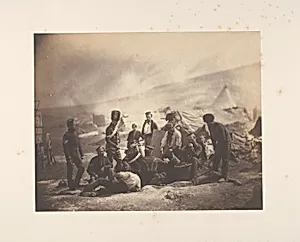
Cooking House of the 8th Hussars
1855
Medium
Salted paper print from glass negative
Dimensions
Image: 15.9 x 20.2 cm (6 1/4 x 7 15/16 in.) Mount: 43.7 x 59.4 cm (17 3/16 x 23 3/8 in.)
Classification
Photographs
Department
Photographs
Museum
Metropolitan Museum of Art, New York, NY
Credit
Gilman Collection, Gift of The Howard Gilman Foundation, 2005
Accession Number
2005.100.187
Rights
Public Domain
Tags
Art Historical Context
In 1855, amid the grueling Crimean War (1853–1856), pioneering photographer Roger Fenton captured *Cooking House of the th Hussars*, a glimpse into the daily life of British soldiers. The 8th Hussars, a light cavalry regiment, endured harsh conditions during the Siege of Sevastopol. This salted paper print reveals their makeshift cooking setup—a humble tent or shelter bustling with soldiers and women, likely camp followers who cooked, washed, and supported the troops. Fenton's image humanizes the war, shifting focus from heroic battles to the gritty routines that sustained the army. As one of the first war photographers, Fenton hauled a mobile darkroom and cumbersome glass negatives to the front lines, producing vivid salted paper prints prized for their soft tonal range and fine detail. This 15.9 x 20.2 cm image exemplifies early wet-collodion photography's technical triumphs, balancing sharp focus with atmospheric depth. Housed in the Metropolitan Museum of Art's Gilman Collection, it underscores photography's emerging power to document history, influencing public perception of conflict and paving the way for modern photojournalism. Today, the work highlights women's overlooked roles in 19th-century warfare, offering visitors a window into the Crimean War's human side—endurance amid adversity.
About the Artist
Roger Fenton · 1819–1819
Roger Fenton (1819–1869), born into a prosperous Lancashire merchant family as the son of banker and MP John Fenton, initially pursued a scholarly path, earning a first-class BA from the University of London in 1840 before studying law at University College London. He abandoned these pursuits for art, training as a painter under the history painter Charles Lucy in London by 1847—the two became clo...