
Untitled
1855
Medium
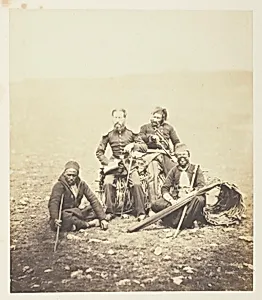
Salted paper print, plate 50 from the album "Photographs Taken in the Crimea" (1856)
Dimensions
Image/paper: 18.2 × 15.6 cm (7 3/16 × 6 3/16 in.); Mount: 58.9 × 42.5 cm (23 1/4 × 16 3/4 in.)
Classification
salted paper print
Department
Photography and Media
Museum
Art Institute of Chicago
Accession Number
146153
Rights
Public Domain
Art Historical Context
This untitled salted paper print by Roger Fenton, created in 1855, is plate 50 from his groundbreaking album *Photographs Taken the Crimea* (185). Fenton, a pioneering British photographer, documented the Crimean War—the first conflict extensively photographed—as the official photographer dispatched by the British government. His images captured the gritty realities of military camps, soldiers, and landscapes during the 1853–1856 war between Russia and an alliance including Britain, France, and the Ottoman Empire, bringing distant battlefields into public view for the first time. The salted paper print, an early wet-collodion process variant, produces the soft, warm tones characteristic of mid-19th-century photography. Measuring just 18.2 × 15.6 cm on its mount, this intimate format invited viewers to closely examine the textures of war—from canvas tents to rugged terrain—highlighting Fenton's technical innovations despite the era's cumbersome equipment and harsh conditions. Housed in the Art Institute of Chicago's Photography and Media Department, this work exemplifies how Fenton's Crimea series revolutionized photojournalism, influencing public opinion on the war and elevating photography as a medium for historical testimony. A poignant window into Victorian-era conflict, it reminds us of photography's power to humanize history.
About the Artist
Roger Fenton · 1819–1819
Roger Fenton (1819–1869), born into a prosperous Lancashire merchant family as the son of banker and MP John Fenton, initially pursued a scholarly path, earning a first-class BA from the University of London in 1840 before studying law at University College London. He abandoned these pursuits for art, training as a painter under the history painter Charles Lucy in London by 1847—the two became clo...