
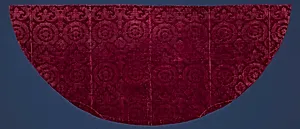
Cope
c. 1500
Medium
Silk, satin weave cut pile-on-pile solid velvet
Dimensions
119.6 × 282.1 cm (47 1/8 × 111 1/8 in.); Repeat: 41.3 × 29.8 cm (16 1/4 × 11 3/4 in.)
Classification
textile
Department
Textiles
Museum
Art Institute of Chicago
Accession Number
74808
Rights
Public Domain
About this artwork
This luxurious expanse of velvet is a cope, a type of priestly garment. Its high quality reflects the wearer’s status. The design of crowns, rosettes, and knots is created by two distinct heights of velvet pile, and the deep crimson color was probably produced by a costly dye derived from dried insects. At one time, it would have also had a richly embroidered band that outlined the front edges when draped over the priest’s shoulders as well as a decorative hood. Because its heaviness and volume ...
Art Historical Context
Step into the opulent world of Renaissance ecclesiastical textiles with this stunning *Cope*, dating to around 1500. A cope is a ceremonial cloak worn by clergy during Catholic liturgies, symbolizing reverence and grandeur. Crafted from luxurious silk in a satin weave cut pile-on-pile solid velvet, piece measures an impressive 119.6 × 282.1 cm, designed to drape dramatically over the shoulders. Its repeating pattern, with a 41.3 × 29.8 cm motif, suggests a woven design likely featuring floral or symbolic motifs common in liturgical vestments of the era. The pile-on-pile technique is a marvel of 15th-century weaving mastery. Here, two layers of velvet pile are created on the loom: one left looped for texture, the other precisely cut to form raised motifs that catch the light, producing a shimmering, almost three-dimensional effect. This labor-intensive method, often practiced in Italian centers like Venice or Genoa, elevated velvet to a status symbol for the Church, blending artistry with spirituality. Housed in the Art Institute of Chicago's Textiles Department, this anonymous masterpiece highlights the Renaissance fusion of technology, trade, and faith. Silk imported via the Silk Road fueled Europe's velvet boom, making such copes rare treasures that adorned altars and processions, whispering tales of devotion across centuries.
About the Artist
Unknown
The artist designated as "Unknown" in our virtual museum's collection exemplifies a poignant chapter in art history: creators whose identities have faded into obscurity despite the enduring power of their work. With only one known artwork attributed to them in our holdings, this figure represents countless anonymous hands that shaped visual culture across centuries. Museums worldwide, including th...