
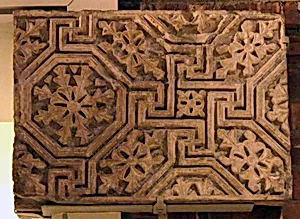
Corner Block from a Frieze with a Meander Pattern of Lines and Rosettes
Unknown Artist
6th century
Medium
Limestone; carved in relief
Dimensions
H. 5 7/8 in. (15 cm) W. 18 7/8 in. (15 cm) D. 4 5/16 in. (11 cm)
Classification
Sculpture
Department
Islamic Art
Museum
Metropolitan Museum of Art, New York, NY
Credit
Rogers Fund, 1907
Accession Number
07.228.38
Rights
Public Domain
Art Historical Context
This exquisite corner block from aieze, carved in low-relief limestone during the 6th century once adorned an architectural structure, likely a building or monument in the early Islamic world. Measuring a modest 5 7/8 inches high by 18 7/8 wide, its compact form hints at its role in a decorative ensemble. The intricate meander—repeating geometric lines forming a labyrinthine "Greek key" motif—intertwines with rosettes, circular floral emblems evoking blooming flowers or stars. These designs reflect the enduring tradition of ornamental abstraction in late antique and early Islamic art, bridging classical influences with emerging regional styles. Crafted with precise chisel work, the relief technique allows the motifs to emerge subtly from the stone's surface, creating shadow play that would have animated the frieze under sunlight. Such patterns held cultural weight, symbolizing continuity, protection, and cosmic order in architecture across the Near East. Acquired through the Rogers Fund in 1907, this piece now resides in the Metropolitan Museum of Art's Islamic Art department, offering a tangible link to the sophisticated stonework of a pivotal era just before Islam's rise, when Byzantine, Sasanian, and local traditions converged.