
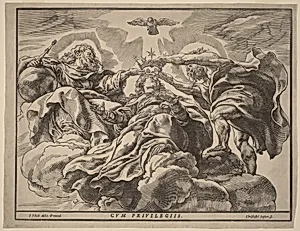
Coronation of the Virgin
Medium
woodcut on laid paper
Dimensions
sheet: 35.7 × 46.2 cm (14 1/16 × 18 3/16 in.)
Classification
Department
CG-E
Museum
National Gallery of Art, Washington, D.C.
Credit
Ailsa Mellon Bruce Fund
Accession Number
1974.34.2
Rights
Public Domain
Art Historical Context
Created in 1633 this woodcut titled *Coronation of the Virgin* represents a collaboration between Flemish master Sir Peter Paul Rubens and skilled printmaker Christoffel Jegher. Rubens, leading figure of the Baroque, was renowned for his compositions, rich color, and emotional intensity in religious subjects. Je translated one of Rubens’s designs into a striking black-and-white print, allowing the dramatic scene of the Virgin Mary’s heavenly crowning to reach viewers far beyond the original painting or altarpiece. Printed on laid paper, the work exemplifies the important role of reproductive prints in the seventeenth century. Woodcuts required the artist to carve away areas of the block, leaving raised lines that would hold ink—an exacting process that demanded both technical precision and artistic sensitivity. By reproducing Rubens’s composition, Jegher helped disseminate the artist’s distinctive style and the Counter-Reformation themes so central to Baroque art across Europe. Measuring roughly 14 by 18 inches, the print now resides in the National Gallery of Art’s collection thanks to the Ailsa Mellon Bruce Fund. It offers today’s visitors a vivid glimpse into how innovative printmaking bridged the worlds of painting and popular devotion, carrying the grandeur of Rubens’s vision into countless homes and churches.