
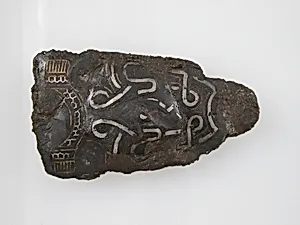
Belt Plate
Unknown Artist
7th century
Medium
Iron, silver inlay, brass inlay
Dimensions
Overall: 3 7/16 x 1 15/16 x 5/16 in. (8.8 x 5 x 0.8 cm)
Classification
Metalwork-Iron
Culture
Frankish
Department
Medieval Art
Museum
Metropolitan Museum of Art, New York, NY
Credit
Gift of J. Pierpont Morgan, 1917
Accession Number
17.193.228
Rights
Public Domain
Art Historical Context
This exquisite 7th-century Frank belt plate, crafted from iron with intricate silver and brass inlays offers a glimpse into the material culture of early medieval Europe. Measuring just 3 7/16 x 1 15/16 x 5/16 inches, its compact size suggests it adorned the belt of a warrior or elite individual, where such accessories served as symbols of status and identity amid the Frankish kingdoms' turbulent expansion across Gaul and beyond. The piece exemplifies Merovingian-era metalwork, a hallmark of Frankish artistry during the 7th century. Artisans employed skilled inlay techniques—embedding silver and brass into the iron base—to create contrasting patterns that highlighted both durability and decoration. Iron provided strength for everyday wear, while the precious metal inlays added luxury, reflecting the Franks' mastery of metallurgy inherited from Roman traditions and adapted for Germanic tastes. Belt fittings like this were often grave goods, underscoring beliefs in the afterlife and social hierarchies. Today, this rare survivor graces the Metropolitan Museum of Art's Medieval Art department, a gift from J. Pierpont Morgan in 1917. It invites us to ponder the lives of those who wore it, bridging the gap between history's grand narratives and intimate personal artifacts.