
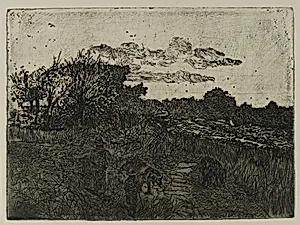
Country at Sunset with Swineherds
n.d.
Medium
Soft ground etching, with aquatint, in black on ivory wove paper
Dimensions
Image/plate: 14.8 × 20 cm (5 7/8 × 7 7/8 in.); Sheet: 34.6 × 44.9 cm (13 5/8 × 17 11/16 in.)
Classification
etching
Department
Prints and Drawings
Museum
Art Institute of Chicago
Accession Number
205089
Rights
Public Domain
Art Historical Context
Giovanni Fattori's *Country at Sunset with Swineher* captures the tranquil beauty of rural Italy in a masterful soft ground etching with aquatint, executed in black ink on ivory wove paper. A leading figure of the Macchiaioli movement—a group of 19th-centurycan realist painters who revolutionized art by prioritizing natural light and everyday scenes over academic idealism—Fattori translated his innovative approach to printmaking. This undated work, measuring 14.8 × 20 cm, exemplifies his skill in rendering atmospheric effects, with the sunset's warm glow bathing swineherds and their charges in subtle tones. The soft ground etching technique allowed Fattori to imprint delicate textures, mimicking the rough cloth of peasants' clothing or the earthy ground, while aquatint provided velvety tonal gradations ideal for evoking dusk's hazy luminosity. These methods, popular in the 19th century, enabled artists like Fattori to achieve painterly depth on paper, bridging painting and print traditions. Housed in the Art Institute of Chicago's Prints and Drawings department, the print's larger sheet (34.6 × 44.9 cm) highlights its intimate scale, inviting close contemplation. This piece reflects Macchiaioli's cultural push against studio-bound art, celebrating humble pastoral life amid Italy's unification era. Fattori's etchings, less common than his oils, offered affordable access to his vision, influencing modern printmakers with their fresh realism. A sunset stroll through the countryside—come explore it!
About the Artist
Giovanni Fattori · 1825–1908
Giovanni Fattori (1825–1908) was born in Livorno and showed such aptitude for drawing that his family redirected him from a planned commercial education to an artistic apprenticeship under the local painter Giuseppe Baldini. In 1846 he moved to Florence, where he studied under Giuseppe Bezzuoli and attended the Academy of Fine Arts. His early work followed the conventions of historical and religio...