
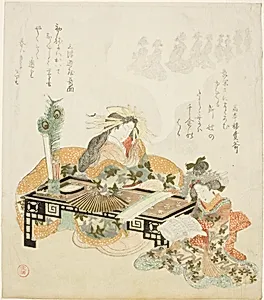
Courtesan Dreaming of Procession
1814
Medium
Color woodblock print; shikishiban, surimono
Dimensions
20.8 × 18.3 cm (8 1/4 × 7 1/4 in.)
Classification
woodblock print
Department
Arts of Asia
Museum
Art Institute of Chicago
Accession Number
81382
Rights
Public Domain
Art Historical Context
In the vibrant world of Edo-period Japan (1603–1868), Kubo Shunman's *Courtesan Dreaming of Procession* (1814) captures the fleeting pleasures of the "floating world" through a delicate color woodblock print. This shikishiban surim—a square-format luxury print privately commissioned for elite patrons—depicts a courtesan lost in reverie, perhaps envisioning a grand festival procession. Shunman (1770–1820), a master ukiyo-e artist and, blended his literary talents with visual artistry, often producing these high-end prints adorned with poems for New Year's greetings or intimate gatherings. The medium's significance shines in its refined techniques: intricate woodblock carving allowed for vibrant colors, subtle gradations (bokashi), and luxurious embellishments like mica dusting or embossing, evoking the courtesan's silken kimono and dreamlike haze. At just 20.8 × 18.3 cm, its intimate scale suited private appreciation, contrasting larger bijin-ga (beauty prints). Housed in the Art Institute of Chicago's Arts of Asia department, it exemplifies surimono's role as collector's art. This piece reflects cultural fascination with Yoshiwara courtesans—symbols of beauty and transience—highlighting ukiyo-e's democratic appeal amid Japan's rigid class structure. A dreamy portal to 19th-century Tokyo's nightlife! (198 words)
About the Artist
Kubo Shunman · 1757–1820
Japanese, 1757–1820