
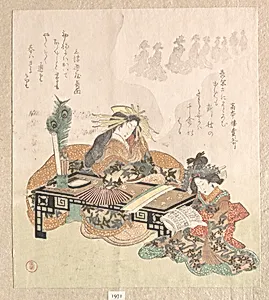
Courtesan Dreaming of the New Year Procession
1814
Medium
Woodblock print (surimono); ink and color on paper
Dimensions
8 1/4 x 7 1/4 in. (21 x 18.4 cm)
Classification
Prints
Culture & Period
Japan · Edo period (1615–1868)
Department
Asian Art
Museum
Metropolitan Museum of Art, New York, NY
Credit
H. O. Havemeyer Collection, Bequest of Mrs. H. O. Havemeyer, 1929
Accession Number
JP1971
Rights
Public Domain
Tags
Art Historical Context
In the vibrant world of Edo-period Japan (1615–1868), Kubo Shunman captures a moment of wistful reverie in his 1814 woodblock *Courtesan Dreaming of the New Year Procession This intimate surimono—a luxurious, privately commissioned print often exchanged as a New Year's greeting—depicts a courtesan from the pleasure quarters, lost in thought while holding a fan and perhaps reading a poetic invitation. The small format (8¼ × 7¼ in.) reflects surimono's bespoke nature, designed for personal appreciation rather than mass production. Shunman's mastery shines in the refined ukiyo-e techniques: vibrant inks and colors layered on paper create a dreamlike haze, blending the woman's serene interior with visions of festive processions outside. Surimono like this often featured embossing, mica dusting, or metallic pigments for tactile elegance, elevating everyday scenes to poetic heights. Courtesans symbolized beauty and transience in Japanese culture, their lives a blend of glamour and melancholy amid rigid social hierarchies. This print, from the Metropolitan Museum of Art's H. O. Havemeyer Collection, offers a window into Japan's floating world, where art celebrated fleeting joys like New Year's revelry. Imagine the courtesan's quiet longing— a poignant reminder of dreams deferred in a time of splendor.
About the Artist
Kubo Shunman · 1757–1820
Japanese, 1757–1820