
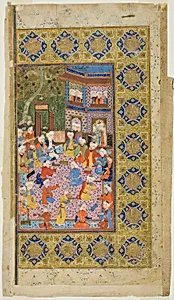
Courtyard of a Palace
Safavid dynasty (1501–1722), 16th century
Medium
Opaque watercolor and ink on paper
Dimensions
Image: 22.9 × 13.1 cm (9 × 5 3/8 in.); Paper: 26.8 × 14.2 cm (10 9/16 × 5 5/8 in.)
Classification
miniature painting
Department
Arts of Asia
Museum
Art Institute of Chicago
Accession Number
52296
Rights
Public Domain
Art Historical Context
Step into the enchanting world of Safavid Persia with *Courtyard of a Palace a exquisite 16th-century miniature from the Islamic artistic tradition Created during the Safavid dynasty (15011722), a golden age for Persian art under Shah Abbas I and his successors, this work captures the splendor of royal architecture. Rendered in opaque watercolor and ink on paper—measuring just 22.9 × 13.1 cm—the painting exemplifies the precision of Persian miniatures, small-scale masterpieces designed for illuminated manuscripts or albums. The scene likely depicts an idealized palace courtyard, a common motif symbolizing paradise gardens (char bagh) in Islamic culture, with intricate tilework, fountains, and lush greenery evoking harmony between humans and nature. Safavid artists, often working in royal workshops (kitabkhaneh), mastered fine ink outlines filled with vibrant, gouache-like pigments, creating a jewel-toned glow that draws the eye to every detail—from archways to figures in flowing robes. Housed in the Art Institute of Chicago's Arts of Asia department, this anonymous gem highlights the dynasty's cultural zenith, blending Persian, Turkish, and Chinese influences. It invites visitors to ponder the opulent courts where poetry, music, and art flourished, offering a window into a refined, cosmopolitan empire.
About the Artist
Islamic
Islamic art, a profound visual tradition originating in the 7th century CE, flourished across vast territories from Spain to India under Muslim rule, encompassing architecture, ceramics, manuscripts, textiles, and metalwork produced by diverse artisans rather than a single named master. Drawing from pre-Islamic Sasanian, Byzantine, and late antique influences, its early development under the Umayy...