
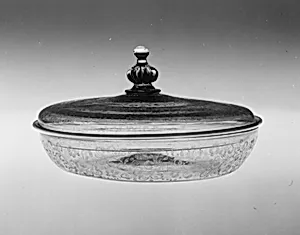
Covered bowl
Unknown Artist
late 16th century
Medium
Colorless (gray) nonlead glass. Blown, modeled, diamond-point (scratch) engraved.
Dimensions
H. with cover 11.2 cm; diam. of cover 20.3 cm
Classification
Glass
Culture
Italian (Venice)
Department
Robert Lehman Collection
Museum
Metropolitan Museum of Art, New York, NY
Credit
Robert Lehman Collection, 1975
Accession Number
1975.1.1214a,b
Rights
Public Domain
Art Historical Context
This elegant covered bowl, crafted in late 16th-century Venice, exemplifies the pinnacle of Renaissance glassmaking from the island of Murano. Made of colorless (gray) nonlead glass—known as *cristallo* for its remarkable clarity and purity—the vessel was meticulously blown into shape, then modeled for precision, and adorned with intricate diamond-point engravings. Standing 11.2 cm high with a 20.3 cm diameter cover, it served as luxurious tableware, showcasing the technical virtuosity that made Venetian glass a coveted export across Europe. Venice's glass industry flourished in the 16th century, protected by strict guild secrets and state monopolies to maintain supremacy in luxury goods. The diamond-point engraving technique, using a diamond-tipped tool to scratch fine designs into the surface, allowed for delicate motifs that highlighted the glass's transparency without added color. This bowl reflects the era's opulence, blending functionality with artistry for elite dining. Now part of the Robert Lehman Collection at The Metropolitan Museum of Art (acquired 1975), it invites us to appreciate how Venetian artisans transformed humble silica into shimmering symbols of refinement, bridging craft and high culture.