
Covered Bowl and Stand
c. 1830/60
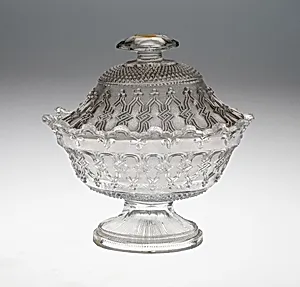
Medium
Glass
Dimensions
19.1 × 22.9 × 14.6 cm (7 1/2 × 9 × 5 3/4 in.)
Classification
bowl
Department
Applied Arts of Europe
Museum
Art Institute of Chicago
Accession Number
10885
Rights
Public Domain
Art Historical Context
Step into the elegant world of 19th-century French luxury the *Covered Bowl and Stand* from Baccarat Glassworks, around 1830–. This exquisite glass piece, measuring 19.1 × 22.9 × 14.6 cm, exemplifies the pinnacle of applied arts, designed for both practical use and display. Housed in the Art Institute of Chicago's Department of Applied Arts of Europe it reflects the opulence of the era's elite dining culture, where finely wrought glassware symbolized refinement and wealth. Baccarat founded in 1764 in Lorraine, France, rose to international fame in the mid-19th century for its masterful lead crystal production. During this period, the firm perfected techniques like deep cutting, engraving, and wheel polishing, creating sparkling, multifaceted surfaces that caught and refracted light dramatically. This bowl and its matching stand likely served as a centerpiece for sweets or preserves, blending functionality with sculptural beauty in the Biedermeier style—characterized by clean lines, geometric motifs, and understated luxury amid post-Napoleonic Europe's neoclassical revival. As a testament to industrial innovation meeting artisanal skill, this object highlights how Baccarat supplied royalty and aristocracy, influencing global tastes in decorative arts. Its preservation offers visitors a tangible glimpse into the craftsmanship that defined French *savoir-faire*.
About the Artist
Baccarat Glassworks
Baccarat Glassworks, founded in 1764 in the Lorraine village of Baccarat, France, emerged from a royal decree by King Louis XV granting Bishop Monseigneur de Montmorency-Laval permission to establish a glass factory. Leveraging abundant local driftwood from the Vosges forest and skilled craftsmen, the works initially produced soda glass for windows, mirrors, and everyday stemware, employing thousa...