
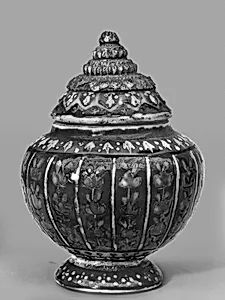
Covered bowl with floral pattern
Unknown Artist
19th century
Medium
Porcelain painted in overglaze polychrome enamels (Bencharong ware for Thai market )
Dimensions
H. 3 3/8 in. (8.6 cm); Diam. 2 5/8 in. (6.7 cm)
Classification
Ceramics
Culture & Period
China · Qing dynasty (1644–1911)
Department
Asian Art
Museum
Metropolitan Museum of Art, New York, NY
Credit
Avery Fund, 1909
Accession Number
09.70.56a, b
Rights
Public Domain
Art Historical Context
This delicate covered bowl, adorned with a vibrant floral pattern, exemplifies the porcelain craftsmanship of China's Qing dynasty (16441911), dating to the 19th century. just 3⅜ inches (8.6 cm) tall with a diameter of 2⅝ inches (6.7 cm), it was produced as Bencharong ware—specially made in Jingdezhen kilns for the Thai market The medium of porcelain painted in overglaze polychrome enamels allowed artisans to apply vivid, multicolored designs after the initial firing, creating luminous hues of red, green, blue, and gold that wouldn't fade under daily use. Bencharong, meaning "five colors" in Thai, reflects the cultural exchange between China and Thailand during the Qing era, when Thai nobility commissioned these luxurious items for elite dining and rituals. The overglaze technique, fired at lower temperatures, enabled intricate floral motifs symbolizing prosperity and harmony, blending Chinese porcelain mastery with Thai aesthetic preferences for bold, narrative patterns. Acquired through the Avery Fund in 1909 and now in the Metropolitan Museum of Art's Asian Art Department, this small treasure highlights the global trade in ceramics, bridging East Asian artistry with Southeast Asian tastes for museum visitors to admire.