
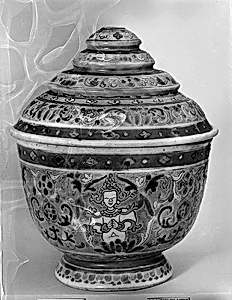
Covered bowl with Thai celestial beings
Unknown Artist
19th century
Medium
Porcelain painted in overglaze polychrome enamels (Bencharong ware for Thai market )
Dimensions
H. 5 3/4 in. (14.6 cm); Diam. 4 1/2 in. (11.4 cm)
Classification
Ceramics
Culture & Period
China · Qing dynasty (1644–1911)
Department
Asian Art
Museum
Metropolitan Museum of Art, New York, NY
Credit
Avery Fund, 1909
Accession Number
09.70.38a, b
Rights
Public Domain
Art Historical Context
This exquisite covered bowl, crafted in 19th-century China during the Qing dynasty (1644–1911), exemplifies Bencharong ware—a specialized porcelain made exclusively for the Thai market. Standing just 5¾ inches tall and 4½ inches in diameter, its compact form belies its vibrant artistry. The porcelain is adorned with overglaze polychrome enamels, a technique where colorful pigments are applied over a fired glaze and refired at lower temperatures to create vivid, durable hues. These enamels capture Thai celestial beings, mythical figures from Buddhist cosmology, blending Chinese technical mastery with Siamese iconography. Bencharong, meaning "five colors" in Thai, was highly prized by Thai royalty and aristocracy, often used for offerings or as status symbols in temple rituals. Produced in Jingdezhen, China's porcelain capital, these pieces highlight the Qing era's export prowess, adapting to foreign tastes while showcasing imperial kilns' finesse. The overglaze method allowed for intricate details impossible in underglaze techniques, making each bowl a cultural bridge between empires. Acquired through the Avery Fund in 1909 and now in the Metropolitan Museum of Art's Asian Art Department, this anonymous masterpiece invites us to ponder the global silk roads of art, where East met Southeast in dazzling splendor.