
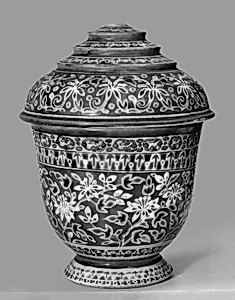
Covered bowl with floral pattern
Unknown Artist
19th century
Medium
Porcelain painted in overglaze polychrome enamels (Bencharong ware for Thai market)
Dimensions
H. 6 1/2 in. (16.5 cm); Diam. 4 1/2 in. (11.4 cm)
Classification
Ceramics
Culture & Period
China · Qing dynasty (1644–1911)
Department
Asian Art
Museum
Metropolitan Museum of Art, New York, NY
Credit
Avery Fund, 1909
Accession Number
09.70.73a, b
Rights
Public Domain
Art Historical Context
This exquisite covered bowl, adorned with a vibrant floral pattern hails from China's Qing dynasty (16441911), crafted in the 19th. Produced as Bencharong ware specifically for the Thai market, exemplifies the porcelain mastery of Jingdezhen kilns, potters created high-quality white bodies exported for elaborate decoration. Measuring just ½ inches high and 4 inches in diameter, its form suggests it was designed for intimate use, perhaps in tea rituals or as a lidded container for precious spices or confections. The bowl's medium—porcelain painted in overglaze polychrome enamels—highlights an innovative technique: artists applied colorful enamels over the fired glaze, then low-fired the piece to fuse the pigments without distorting the smooth surface. This allowed for the bold, jewel-like hues of Bencharong ("five colors" in Tibetan, reflecting its palette), featuring floral motifs that resonated with Thai aristocratic tastes, symbolizing abundance and harmony. Such wares bridged Chinese technical prowess with Southeast Asian aesthetics, underscoring vibrant trade networks across Asia. Acquired by the Metropolitan Museum of Art in 1909 through the Avery Fund, this piece from the Asian Art department invites us to appreciate the Qing era's global reach, where ceramics became cultural ambassadors blending East and Southeast Asian worlds.