
Covered Jar (Albarello)
Unknown Artist
second half 13th–14th century
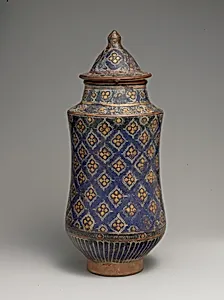
Medium
Stonepaste; overglaze painted and leaf gilded (lajvardina)
Dimensions
H. 14 3/4in. (37.5cm) H with cover: 14 3/4in. (37.5cm)
Classification
Ceramics
Department
Islamic Art
Museum
Metropolitan Museum of Art, New York, NY
Credit
Henry G. Leberthon Collection, Gift of Mr. and Mrs. A. Wallace Chauncey, 1957
Accession Number
57.61.12a, b
Rights
Public Domain
Art Historical Context
This elegant Covered Jar, known as an *albarello*, hails from the Islamic world during the second half of the 13 to 14th century. Standing at 14¾ inches tall with its lid, it exemplifies the refined ceramics produced in regions like Persia (modern-day Iran), where such vessels were prized for both utility and beauty. Albarellos were specifically designed for apothecaries to store medicinal herbs drugs, their cylindrical shape with a narrowed neck allowing easy access while preventing spills—a clever fusion of form and function that influenced European pottery traditions. Crafted from stonepaste—a composite of quartz, clay, and glass frit that mimics porcelain's translucency—the jar showcases the luxurious *lajvardina* technique. This involved overglaze painting in deep cobalt blue (evoking lapis lazuli) and delicate gold leaf gilding, fired at low temperatures to create a shimmering luster. Popular in 13th-century Kashan workshops, *lajvardina* represented technical innovation and opulence, reserved for elite patrons. Though the artist remains unknown, this piece reflects the golden age of Islamic ceramics, blending artistry with everyday Islamic cultural practices like pharmacology and trade along the Silk Road. On view in the Metropolitan Museum of Art's Islamic Art department, gifted in 1957, it invites us to marvel at medieval ingenuity—where science, splendor, and skill converged.