
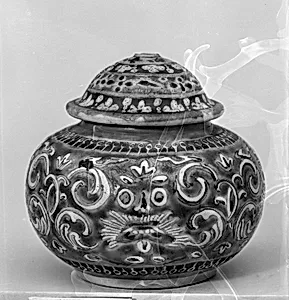
Covered jar with animal masks
Unknown Artist
19th century
Medium
Porcelain painted in overglaze polychrome enamels (Bencharong ware for Thai market )
Dimensions
H. 2 1/4 in. (5.7 cm); Diam. 2 1/4 in. (5.7 cm)
Classification
Ceramics
Culture & Period
China · Qing dynasty (1644–1911)
Department
Asian Art
Museum
Metropolitan Museum of Art, New York, NY
Credit
Avery Fund, 1909
Accession Number
09.70.67a, b
Rights
Public Domain
Art Historical Context
This delicate covered jar, adorned with animal masks, exemplifies the exquisite porcelain craftsmanship of China's Qing dynasty (16441911) in the 19th century Measuring just 2¼ inches (5.7 cm) in height and diameter, its petite scale suggests it was designed for intimate, elite use—perhaps as a container for cosmetics, spices, or precious oils. Produced for the Thai market as Bencharong ware, reflects the vibrant cultural exchanges along ancient trade routes, where Chinese artisans catered to Southeast Asian nobility. The jar's medium—porcelain painted in overglaze polychrome enamels—is a hallmark of Bencharong, named for the Thai term meaning "five colors," though pieces often burst with more vivid hues like reds, blues, golds, and greens. These enamels, fired at low temperatures over a glazed surface, allowed for intricate, multi-layered designs that captured mythical animal masks, blending Chinese technical mastery with Thai aesthetic preferences for bold, symbolic motifs evoking protection and prosperity. Acquired through the Avery Fund in 1909 and now in the Metropolitan Museum of Art's Asian Art collection, this jar highlights the Qing era's export porcelain boom, showcasing how global tastes fueled artistic innovation and luxury trade across Asia.