
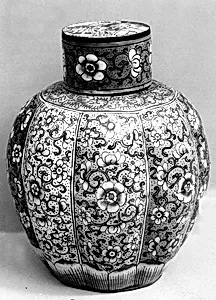
Covered Tea Caddy
Unknown Artist
18th–19th century
Medium
Painted enamel
Dimensions
H. 4 3/4 in. (12.1 cm)
Classification
Enamels
Culture & Period
China · Qing dynasty (1644–1911)
Department
Asian Art
Museum
Metropolitan Museum of Art, New York, NY
Credit
Bequest of Margarette A. Jones, 1906
Accession Number
07.233.1a, b
Rights
Public Domain
Art Historical Context
This elegant Covered Tea Caddy, created during China’s Qing dynasty in the 18th or 19th century, exemplifies the refined enamelwork that flourished under imperial patronage. Standing just under five inches tall, the compact vessel was designed to store precious tea leaves, reflecting tea’s central role in daily life, social rituals, and trade during this prosperous era. Its classification as painted enamel highlights a technique in which artists applied colored enamels directly onto a metal surface before multiple firings, achieving luminous hues and fine detail without the need for metal wires used in cloisonné. The caddy’s floral motifs, delicately rendered across its surface, speak to the Qing period’s appreciation for natural beauty and symbolic ornament. Such pieces were often crafted in imperial or private workshops for both domestic use and export, blending utility with artistic sophistication. Today, this bequest to the Metropolitan Museum of Art offers visitors a glimpse into the technical mastery and cultural elegance of Qing decorative arts.