
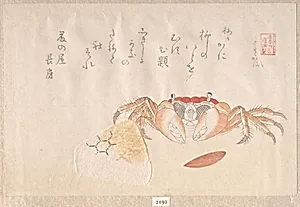
Crab, Baked Rice-Ball and Seed of Persimmon
19th century
Medium
Woodblock print (surimono); ink and color on paper
Dimensions
5 7/16 x 8 1/4 in. (13.8 x 21 cm)
Classification
Prints
Culture & Period
Japan · Edo period (1615–1868)
Department
Asian Art
Museum
Metropolitan Museum of Art, New York, NY
Credit
H. O. Havemeyer Collection, Bequest of Mrs. H. O. Havemeyer, 1929
Accession Number
JP2192
Rights
Public Domain
Tags
Art Historical Context
Nestled in the Metropolitan Museum of Art's Asian Art collection, *Crab, Baked Rice-B and Seed of Persim* is a charming 19th-century woodblock print (imono) by Kubo Shunman, a master of Japan's Edo period (1615–1868). Crafted with ink and color on paper, intimate work measures just 5 7/16 x 8 1/4 inches, perfect for personal appreciation. Shunman, a poet and ukiyo-e artist, excelled in capturing everyday beauty with poetic finesse, blending and whimsy in his compositions. Surimono prints like this one were luxurious, privately commissioned pieces, often produced for New Year's greetings or poetry gatherings among literati. Unlike mass-produced ukiyo-e, they featured refined techniques such as subtle color gradations (bokashi), embossing, and mica dusting for a shimmering effect—evident in the textured crab shell and glossy rice-ball. The still-life subjects—a plump crab, steaming baked rice-ball (nikiri-manju or onigiri variant), and lone persimmon seed—evoke seasonal abundance and impermanence, hallmarks of Japanese aesthetics like mono no aware. From the esteemed H. O. Havemeyer Collection, this print highlights Shunman's role in elevating humble motifs to art, bridging culinary culture and visual poetry during Edo Japan's vibrant printmaking golden age. A delightful window into private refinement!
About the Artist
Kubo Shunman · 1757–1820
Japanese, 1757–1820