
Cream jug
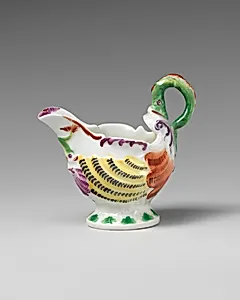
Medium
Soft-paste porcelain
Classification
Ceramics-Porcelain
Culture
British, Worcester
Department
European Sculpture and Decorative Arts
Museum
Metropolitan Museum of Art, New York, NY
Credit
Gift of Mrs. Constance D. Stieglitz, in memory of her husband, Marcel H. Stieglitz, 1964
Accession Number
64.142.82
Rights
Public Domain
Tags
Art Historical Context
This elegant cream jug, produced by the Worcester factory during the Dr. Wall Period 1765, exemplifies the golden age of British porcelain making. Founded in 1751, the Worcester factory—under the leadership of Dr. John—quickly rose to prominence by developing high-quality soft-paste porcelain, a bone-ash formula that mimicked the translucency of coveted Chinese hard-paste wares without relying on scarce kaolin clay. This innovation allowed British manufacturers to flood the market with affordable luxury tableware, making fine ceramics accessible to the growing middle class. Crafted from soft-paste porcelain, the jug features delicate underglaze painting, likely adorned with bird motifs that capture the period's fascination with naturalism. These avian designs, common in Worcester's output, reflect the Rococo influence with their lively, colorful interpretations of British wildlife, often inspired by exotic imports and local ornithology. The form itself—a practical yet refined pitcher for tea service—highlights the factory's mastery of molding and firing techniques, ensuring durability alongside ornamental appeal. Housed in the Metropolitan Museum of Art's Department of European Sculpture and Decorative Arts, this piece was a generous gift in 1964, honoring everyday elegance from Georgian England. It invites visitors to appreciate how porcelain bridged art and utility, transforming the simple act of serving cream into a display of sophistication and national pride.
About the Artist
Worcester factory|Dr. Wall Period · 1751–2008
The Worcester porcelain factory, established in 1751 in Worcester, England, by physician Dr. John Wall and apothecary William Davis along with 14 partners, marked the birth of one of Britain's most enduring ceramic enterprises. Investing £4,500 at Warmstry House on the River Severn, the founders drew on contacts with the Bristol porcelain manufactory to develop a novel soft-paste porcelain using s...