
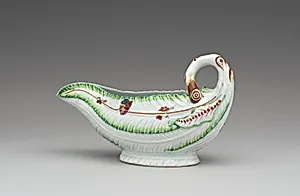
Sauceboat (one of a pair)
Medium
Soft-paste porcelain
Dimensions
Overall: 4 1/8 × 7 1/4 in. (10.5 × 18.4 cm)
Classification
Ceramics-Porcelain
Culture
British, possibly Worcester or Bow, London
Department
European Sculpture and Decorative Arts
Museum
Metropolitan Museum of Art, New York, NY
Credit
Gift of Mr. and Mrs. Luke Vincent Lockwood, 1939
Accession Number
39.140.184
Rights
Public Domain
Art Historical Context
This elegant sauceboat, one of a crafted around 1755, exemplifies the early ingenuity of British porcelain makers at either the Worcester factory or London's Bow Porcelain Factory. Produced during a golden age of European ceramics, it reflects Britain's drive to rival Chinese imports, which had captivated aristocrats with their translucent beauty. Soft-paste porcelain medium here—was a clever British innovation, blending clay, ground glass, and other materials fired at lower temperatures to mimic the prized hard-paste from Asia, though it was slightly less durable. Measuring just over 4 inches high and 7 inches long, this petite vessel was designed for refined table service, likely holding savory sauces during lavish dinners. Its delicate form highlights the factories' mastery of molding and glazing techniques, enabling intricate shapes suited to neoclassical tastes. As part of the Metropolitan Museum of Art's European Decorative Arts collection—gifted in 1939—this piece underscores the cultural shift toward accessible luxury in 18th-century Britain, where porcelain became a status symbol for the emerging middle class. Wanderers through our virtual halls, picture it gleaming amid silver and crystal, a testament to industrial ambition and artistic finesse!
About the Artist
Worcester factory|Bow Porcelain Factory · 1751–2008
The Worcester porcelain factory, established in 1751 in Worcester, England, by physician Dr. John Wall and apothecary William Davis along with 14 partners, marked the birth of one of Britain's most enduring ceramic enterprises. Investing £4,500 at Warmstry House on the River Severn, the founders drew on contacts with the Bristol porcelain manufactory to develop a novel soft-paste porcelain using s...