
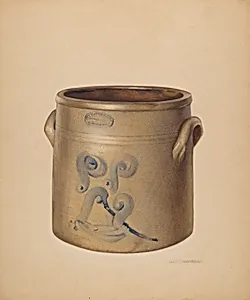
Crock
c. 1937/1938
Medium
watercolor, colored pencil, and graphite on paperboard
Dimensions
overall: 45.5 x 38.3 cm (17 15/16 x 15 1/16 in.) Original IAD Object: 9" High 9 1/2" Dia(top) 9 5/8" Dia.(bot.)
Classification
Index of American Design
Department
CG-W
Museum
National Gallery of Art, Washington, D.C.
Credit
Index of American Design
Accession Number
1943.8.5059
Rights
Public Domain
Art Historical Context
**Crock**, a meticulous rendering by artists George Loughridge and Yol Delasser around 1937–1938, captures the humble yet essential form of a traditional American earthenware crock. Created as watercolor, colored pencil, graphite on paperboard (45.5 × 38.3 cm), it depicts a sturdy storage vessel measuring about 9 inches high a slightly flared top (9½ inches diameter) and broader base (9⅝ inches). Such crocks were everyday staples in colonial and early American households, used for preserving food like pickles, sauerkraut, or butter, embodying the practicality of folk craftsmanship. This artwork is part of the *Index of American Design*, a landmark WPA Federal Art Project from the Great Depression era (1935–1942). Over 18,000 such plates documented America's diverse decorative arts, from Native American pottery to Shaker furniture, to celebrate national heritage and support artists amid economic hardship. Loughridge and Delasser's precise mixed-media technique—blending fluid watercolor washes for subtle glazes, colored pencil for fine details, and graphite for sharp outlines—highlights the crock's simple curves and earthy tones, elevating utilitarian objects to icons of cultural identity. Displayed in the National Gallery of Art's collection, *Crock* reminds us how ordinary items reflect America's resourceful spirit, bridging art, history, and daily life.