
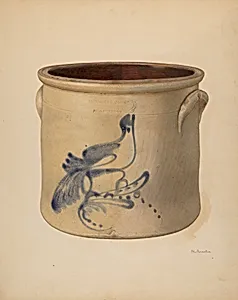
Crock
c. 1939
Medium
watercolor and graphite on paperboard
Dimensions
overall: 45.7 x 28.4 cm (18 x 11 3/16 in.) Original IAD Object: 9 5/8" High 10" Dia(top) 10" Dia(bot)
Classification
Index of American Design
Department
CG-W
Museum
National Gallery of Art, Washington, D.C.
Credit
Index of American Design
Accession Number
1943.8.7002
Rights
Public Domain
Art Historical Context
**Crock** by Nicholas Amantea (c. 1939) is a delicate watercolor and graphite rendering on paperboard, capturing the humble elegance of a traditional American earthenware storage vessel. Measuring 45.7 x 28.4 cm, this work meticulously documents a crock—typically a wide-mouthed ceramic jar used for preserving food like pickles or salted meats in colonial and early American households. The original object, standing about 24.5 cm high with a 25.4 cm diameter at both top and bottom, exemplifies everyday folk pottery from rural America. Created as part of the Index of American Design (IAD), a Works Progress Administration (WPA) project during the Great Depression, Amantea's piece preserves vanishing examples of American craftsmanship. Launched in 1935, the IAD employed artists to produce over 18,000 watercolor studies of folk art, furniture, and utilitarian objects, celebrating the nation's cultural heritage amid economic hardship. Graphite outlines lend precision to the subtle glazes and forms, while watercolor evokes the pot's earthy tones, highlighting techniques like wheel-throwing and simple glazing. This artwork underscores the artistic value in ordinary objects, bridging fine art with functional design. Housed in the National Gallery of Art's collection, it invites visitors to appreciate how such crocks embodied self-sufficiency and regional traditions in pre-industrial America.
About the Artist
Nicholas Amantea · 1900–1978
Nicholas Amantea (1900–1978) was an American artist born on July 13, 1900, in Pittsburgh, Pennsylvania. His early life and artistic training are not well documented, but by the mid-1930s, he had established himself in New York City, where he contributed significantly to federal art initiatives during the Great Depression. From March 13, 1936, to July 15, 1942, Amantea worked for the Works Progress...