
Crock
probably 1937/1938
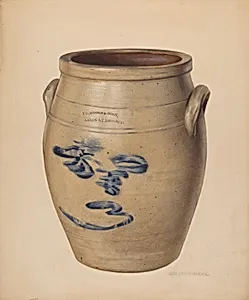
Medium
watercolor and graphite on paperboard
Dimensions
overall: 45.5 x 37.9 cm (17 15/16 x 14 15/16 in.) Original IAD Object: 12 1/4" High 8 1/2" Dia(top) 6 3/4" Dia(base)
Classification
Index of American Design
Department
CG-W
Museum
National Gallery of Art, Washington, D.C.
Credit
Index of American Design
Accession Number
1943.8.6350
Rights
Public Domain
Art Historical Context
**Crock**, a meticulous rendering by artist George Loughridge around 1937–1938, captures the humble elegance of a traditional American earthenware storage jar.ed in watercolor and graphite on paperboard (45.5 × 37.9 cm), this work faithfully reproduces a crock measuring 12¼ inches high, with an 8½-inch top diameter tapering to 6¾ inches at the base. The subtle glazes, sturdy form, and practical design reflect everyday folk pottery used for preserving food like pickles or cider in 19th-century American homes. Created as part of the Index of American Design—a Federal Art Project under the Works Progress Administration (WPA) during the Great Depression—this piece exemplifies a national effort to document and celebrate vernacular American crafts. From 1935 to 1942, artists like Loughridge produced over 15,000 precise, colorful illustrations of objects ranging from quilts to tools, preserving cultural heritage amid economic hardship. Housed in the National Gallery of Art's collection, it highlights how such renderings elevated utilitarian items to art, bridging craft and fine art traditions. Loughridge's technique blends watercolor's luminosity for glints and shadows with graphite's precision for contours, making the crock's textures almost tangible. Today, it invites visitors to appreciate the artistry in America's everyday past.
About the Artist
George Loughridge · 1855–present
George Loughridge was an American artist active during the 1930s, best known for his contributions to the Index of American Design, a Federal Art Project under the Works Progress Administration (WPA). This ambitious New Deal initiative, running from 1935 to 1943, commissioned hundreds of artists across the United States to create meticulously detailed watercolor renderings of everyday American fol...