
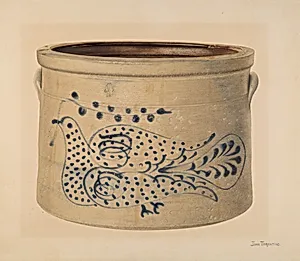
Crock
c. 1940
Medium
watercolor and graphite on paperboard
Dimensions
overall: 38.2 x 50.9 cm (15 1/16 x 20 1/16 in.) Original IAD Object: 9 1/4" High 12 1/2" Dia(top) 12" Dia(base)
Classification
Index of American Design
Department
CG-W
Museum
National Gallery of Art, Washington, D.C.
Credit
Index of American Design
Accession Number
1943.8.6362
Rights
Public Domain
Art Historical Context
Behold the humble yet elegant *Crock*, a captivating watercolor and graphite rendering by John Tarantino, created around 1940. This precise depiction captures a classic earthenware vessel—measuring about 9¼ inches high with a 12½-inch top diameter and 12-inch base—evoking the sturdy pottery essential to American homes. Tarantino's work, on paperboard sized 38.2 x 50.9 cm, the crock's simple, functional form, likely glazed in earthy tones that highlight its utilitarian beauty. As part of the Index of American Design (IAD), a groundbreaking Federal Art Project under the Works Progress Administration (WPA) from 1935 to 1942, this piece belongs to a vast archive of over 18,000 renderings documenting America's folk art and craftsmanship. During the Great Depression, artists like Tarantino preserved vanishing traditions through meticulous studies, ensuring cultural heritage endured amid economic hardship. Housed in the National Gallery of Art's collection, it celebrates the anonymous potters whose work underpinned everyday life. Tarantino's technique blends watercolor's luminous washes for texture and color with graphite's fine lines for architectural accuracy, making the three-dimensional object leap from the flat surface. Crocks like this were vital for storing preserves, butter, or water, symbolizing self-reliant pioneer spirit and regional pottery traditions from the 19th century. A testament to American ingenuity, it invites us to appreciate the artistry in the ordinary.
About the Artist
John Tarantino · 1855–present
John Tarantino was an American artist active from around 1935 to 1953, best known for his meticulous contributions to the Index of American Design, a Federal Art Project under the Works Progress Administration (WPA). This ambitious initiative commissioned artists across the United States to create precise renderings of everyday folk art objects, preserving the nation's vernacular design heritage a...