
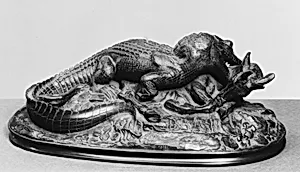
Crocodile Devouring Antelope
19th century
Medium
Bronze
Dimensions
Overall: 6 3/8 × 16 1/2 × 9 in. (16.2 × 41.9 × 22.9 cm)
Classification
Sculpture-Bronze
Culture
French
Department
European Sculpture and Decorative Arts
Museum
Metropolitan Museum of Art, New York, NY
Credit
Bequest of Miss May Maghee, 1895
Accession Number
95.10.2
Rights
Public Domain
Tags
Art Historical Context
In the European Sculpture and Decorative Arts of the Metropolitan Museum of, Antoine-Louis Bary *Crocodile Devouring Antelope* (19th century) captures the raw ferocity of nature in exquisite bronze. This compact yet powerful sculpture, measuring 63/8 × 16 1/2 × 9 inches, depicts a crocodile mid-feast on its prey, with tensed muscles and dynamic tension that freeze a brutal moment from the wild. Barye, a pioneering French animalier sculptor, bridged Romanticism and Realism during the 19th century, elevating animal subjects from mere decoration to profound studies of life and struggle. His mastery of bronze—likely cast using the lost-wax technique—allowed for intricate details in scales, fur, and anatomy, bringing an almost lifelike intensity to the scene. This work exemplifies the era's fascination with exotic wildlife, inspired by zoological discoveries and a Romantic idealization of nature's untamed power. A generous bequest from Miss May Maghee in 1895 brought this piece to the Met, where it stands as a testament to Barye's influence on modern sculpture. Visitors are drawn to its visceral energy, reminding us of the wild world's unyielding drama.
About the Artist
Antoine-Louis Barye · 1795–1875
Antoine-Louis Barye (1795–1875) was born in Paris on September 24, the son of goldsmith Pierre Barye and Marguerite Barye. Following family tradition, he apprenticed as a goldsmith under his father and, around 1810, with Martin-Guillaume Biennais, goldsmith to Napoleon. After brief military service, Barye pursued sculpture, studying under François-Joseph Bosio in 1816 and painter Baron Antoine-Jea...