
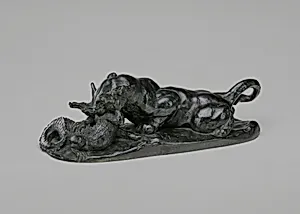
Jaguar Devouring a Crocodile
model n.d., cast c. 1862/1873
Medium
bronze
Dimensions
overall: 7.94 × 24.13 × 9.53 cm (3 1/8 × 9 1/2 × 3 3/4 in.)
Classification
Sculpture
Department
CSD
Museum
National Gallery of Art, Washington, D.C.
Credit
Corcoran Collection (Museum Purchase)
Accession Number
2015.19.3840
Rights
Public Domain
Art Historical Context
Antoine-Louis Barye *Jaguar Devouring aodile* is a striking bronze sculpture that captures the raw ferocity of the natural world. Created from a model of unknown date and cast around 1862–1873, this compact piece measures just 7.94 × 24.13 × 9.53 cm, making it an intimate yet powerful tabletop study. Barye, a pioneering French animalier sculptor of the Romantic era, specialized in dynamic depictions of wild animals, blending scientific precision with dramatic tension. In the 19th century, Barye revolutionized sculpture by moving beyond classical mythology to portray beasts in lifelike combat, reflecting the era’s fascination with exotic nature and Darwinian themes of survival. His mastery of bronze casting allowed for intricate details—the jaguar’s tensed muscles, gleaming fangs, and the crocodile’s scaly struggle—rendered with a patina that enhances the lifelike sheen. This work exemplifies his technique of lost-wax casting, enabling multiple editions from enduring models. Now part of the National Gallery of Art’s Corcoran Collection, the sculpture invites visitors to ponder humanity’s place amid nature’s primal forces. Barye’s vivid realism not only showcases technical virtuosity but also embodies the Romantic ideal of untamed wilderness, making it a timeless highlight for animal art enthusiasts.
About the Artist
Antoine-Louis Barye · 1795–1875
Antoine-Louis Barye (1795–1875) was born in Paris on September 24, the son of goldsmith Pierre Barye and Marguerite Barye. Following family tradition, he apprenticed as a goldsmith under his father and, around 1810, with Martin-Guillaume Biennais, goldsmith to Napoleon. After brief military service, Barye pursued sculpture, studying under François-Joseph Bosio in 1816 and painter Baron Antoine-Jea...