
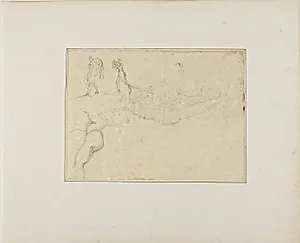
Cross-Section of a Pillared Hall and Three Figure Sketches
Medium
Graphite, on tan wove paper, perimeter mounted on ivory laid paper
Dimensions
17 × 23.1 cm (6 3/4 × 9 1/8 in.)
Classification
graphite
Department
Prints and Drawings
Museum
Art Institute of Chicago
Accession Number
113395
Rights
Public Domain
Art Historical Context
In the Prints and Drawings department of the Institute of Chicago rests a captivating preparatory drawing by Théodore Géricault the French Romantic master renowned for his dramatic canvases like *The Raft of the Med*. Titled *Cross-Section of a Pillared Hall and Three Figure Sketches*, this 1813/14 work on tan wove paper measures a modest 17 × 23.1 cm, revealing Géricault's meticulous graphite technique during his early twenties. Created amid the Napoleonic era's turbulence, it showcases his architectural precision alongside fluid figure studies, hinting at his lifelong fascination with human anatomy and spatial drama. Géricault's Romantic style emphasized raw emotion and movement, and this sheet exemplifies his virtuoso draftsmanship. The detailed cross-section of a pillared hall—likely inspired by classical or neoclassical influences—contrasts with the expressive, loosely rendered figures, demonstrating how he blended architectural rigor with the vitality of the human form. Graphite on wove paper allowed for subtle tonal gradations and fine lines, ideal for such multifunctional sketches that bridged study and composition. Perimeter-mounted on ivory laid paper for preservation, this intimate work offers visitors a glimpse into Géricault's creative process, underscoring his versatility before his meteoric rise. It's a testament to how even small drawings fueled the bold visions of Romanticism.
About the Artist
Jean Louis André Théodore Géricault · 1791–1824
Jean-Louis André Théodore Géricault (1791–1824) was born into a prosperous bourgeois family in Rouen, France, the son of a lawyer who managed the family tobacco business. After moving to Paris around 1797, his artistic talent emerged early, nurtured in a circle that included his maternal uncle Jean-Baptiste Caruel and art dealer Jean-Louis Laneuville. Géricault began formal training in 1808 under ...